Last updated: March 2026 Anyone comparing crypto tax software for Belgium usually is not just comparing features. Above all, you are comparing how much extra manual work remains between a rough calculation and a usable Belgian file. That is exactly where a Belgian tool differs from general international crypto tax tools. Many generic tools are useful as a starting point: they import transactions, calculate gains...
Last updated: March 2026
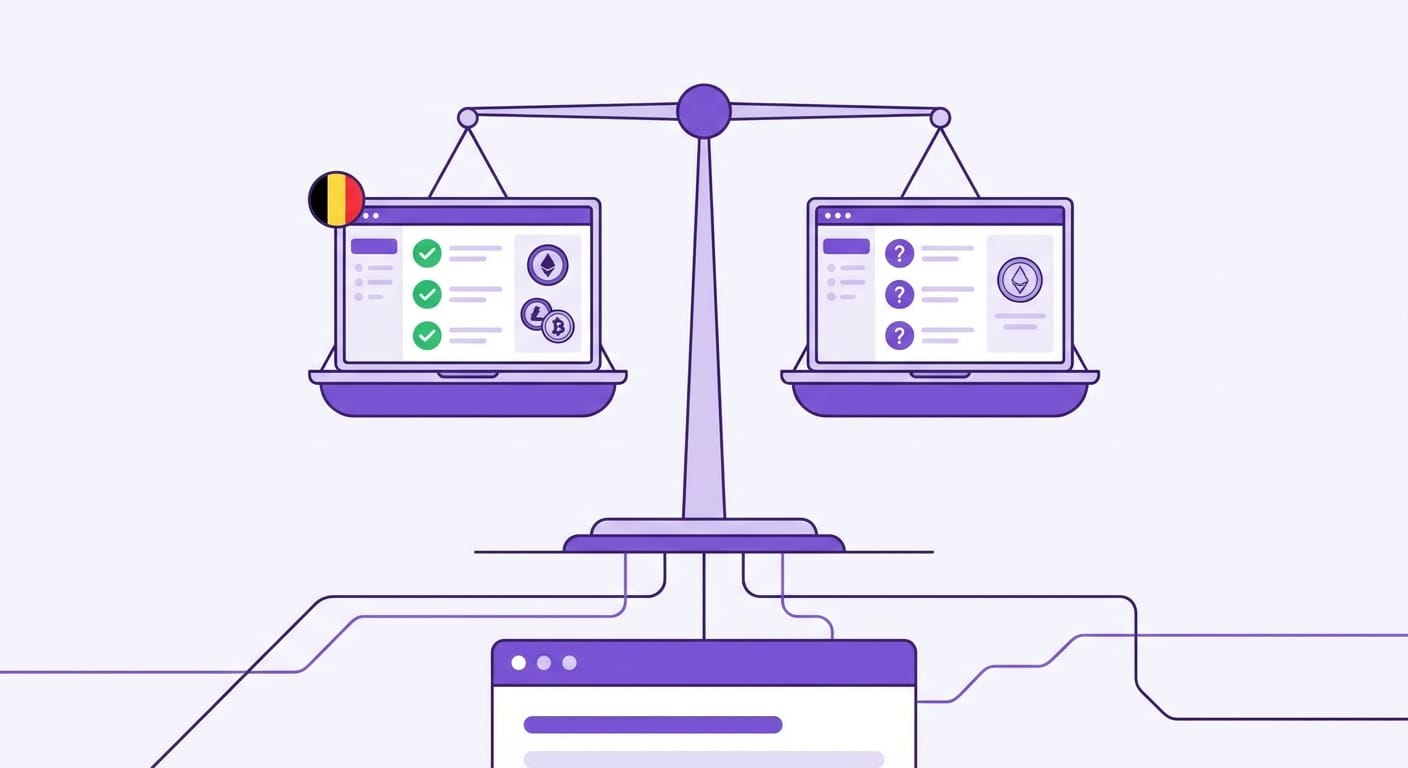
Anyone comparing crypto tax software for Belgium usually is not just comparing features. Above all, you are comparing how much extra manual work remains between a rough calculation and a usable Belgian file. That is exactly where a Belgian tool differs from general international crypto tax tools.
Many generic tools are useful as a starting point: they import transactions, calculate gains and produce an export. But for Belgian users the extra work often only starts after that. You still have to check results in euros, review wallet and DeFi activity, and translate the output into something you or your accountant can actually work with.
Why Belgian specificity saves time in practice
Belgium has its own fiscal context, its own accountant expectations and a different review flow than the markets many international tools were originally built for. As a result, the difference is not only in “does it support Belgium yes or no”, but in the entire workflow:
- FIFO in EUR as a working basis: you want to be able to understand, check and discuss amounts in euros without extra translation steps.
- Tax-on-Web/accountant readiness: the report must not only be complete, but also logically usable in a Belgian file.
- Wallets, staking and DeFi: as soon as you go beyond simple exchange trades, the chance of manual cleanup in generic tools increases.
- Local trust: Belgian users want clear information about security, hosting and the way data is shared with an accountant.
That does not mean every general tool is bad. It does mean Belgian users more often still have to take extra steps after the tool appears to be done.
Where general crypto tax tools often create extra work
With many international solutions, the process for Belgian users looks roughly like this:
- Create an export from the tool and then check yourself which output you actually need.
- Do a EUR review because the calculation or discussion ultimately has to happen in euros anyway.
- Go through wallet and DeFi data to see whether staking, bridges, swaps and protocol interactions have been processed logically.
- Restructure the report so your accountant or your own filing flow can work with it.
- Add context because a generic tax summary is not automatically the same as a Belgian report.
For Belgian users this is often the hidden cost of a generic tool: not the license itself, but the hours that afterwards still go into checking and translation.
How CryptoTax tries to make the difference
CryptoTax is positioned around Belgian review and reporting. You can see this above all in the combination of calculator, report and public documentation:
- Belgian calculator flow: start with the crypto tax calculator for Belgium to estimate your situation first.
- A report you can discuss with an accountant: check the public sample report and Tax-on-Web mapping page to see how the output is built up.
- Wallet + DeFi focus: CryptoTax supports exchange imports, wallets and protocol activity so you do not just summarize an exchange CSV.
- Security explained publicly: on the page about how CryptoTax secures your data you can see how API keys, hosting and access are handled.
The intention is not to claim that no checking is ever needed. The intention is that the workflow is already closer to what a Belgian user needs when it is time to review, share or report.
Tax-on-Web and accountant consultation
An important difference for Belgian buyers is that the endpoint is usually not a “global tax summary”. The endpoint is a file you understand, that your accountant can review and that fits the Belgian filing practice. That is why it is more useful to evaluate a tool on:
- how clearly amounts and categories are presented,
- how little extra spreadsheet work is still needed,
- how easily you can share or explain your results,
- and whether the documentation matches Belgian questions instead of international defaults.
If you want to see that concretely, open the Tax-on-Web mapping page. It shows better than any marketing text how close the output already is to a Belgian review process.
DeFi, staking and transfers are no longer edge cases
Many Belgian users today do not only have spot trades on an exchange. They have wallet transfers, staking, bridge usage and DeFi protocols. That is exactly where generic tools more often require extra correction work.
That is why CryptoTax positions itself not just as an “exchange tax tool”, but as a broader Belgian workflow for:
- wallet transactions on Ethereum, Base and Arbitrum,
- staking and reward-like flows,
- swaps, bridges and internal transfers,
- and reports that remain readable for accountant review.
If you have a lot of wallet or protocol activity, that is one of the fastest ways to assess whether an international tool really saves you time or mainly delivers a first export.
Local trust matters too
For a Belgian buyer it is not only about the calculation. It is also about trust: where is data hosted, how are API keys handled, what access do you give your accountant and how much explanation do you get about it publicly? CryptoTax makes that information visible via the security page and the public report page for accountants.
This matters because software choice in this category is rarely purely mathematical. You also buy trust in the workflow, the output and the way sensitive financial data is handled.
Which pages should you compare side by side as a buyer?
If you want to compare CryptoTax fairly with general crypto tax tools, look at at least these three pages together:
- Calculator to assess the entry flow
- Pricing to see how the free scan, report and heavier usage compare
- Sample report to assess the quality of the output
Do you want to place the broader fiscal context alongside the product comparison? Then also read the Belgian crypto tax guide.
Getting started
Do you not want to keep comparing on abstract claims? Then start with the Belgian calculator, then check the sample report, and finally decide based on the pricing page whether the workflow fits your file.