
Europe reprimands Belgium for failing to transpose the DAC8 directive. But the obligation to declare crypto capital gains already existed on 1 January 2026.
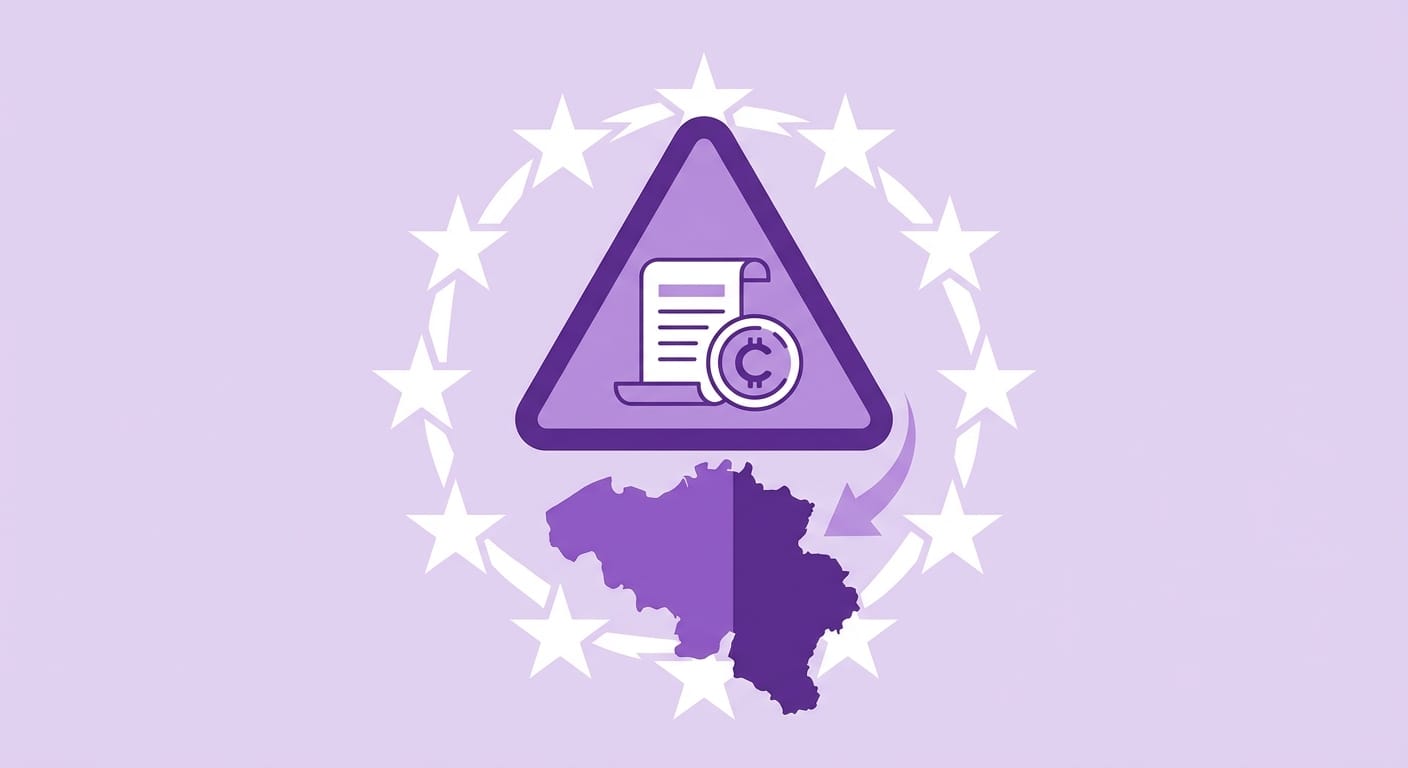
On 30 January 2026, the European Commission took a decision that should have jolted Belgian crypto investors awake, even if the wider public heard little about it. In its monthly infringement package, the Commission opened formal proceedings against twelve EU member states, including Belgium, for failing to transpose the DAC8 directive into national law on time. What few people know: in that same package, Belgium also appears on a second list, for a related tax directive. That is no detail.
But perhaps the most surprising aspect of this story is what does not change for ordinary Belgian investors: their obligation to declare capital gains on crypto already existed on 1 January 2026 and still exists, regardless of the European infringement procedure.
What is DAC8 and why is Belgium on the list?
DAC8 (officially Directive (EU) 2023/2226) is the European rule that requires crypto platforms to automatically forward customer data and transactions to national tax authorities. In concrete terms: a Belgian user of Kraken, Binance or Coinbase would automatically come "into view" at FPS Finance (FOD Financiën) via DAC8, without having to do anything themselves. That is a fundamental shift in how the tax authorities gain visibility into crypto holdings.
The transposition deadline for DAC8 was the end of 2025. Belgium missed it. The same applies to Bulgaria, the Czech Republic, Estonia, Greece, Spain, Cyprus, Luxembourg, Malta, the Netherlands, Poland and Portugal. Twelve countries in total.
The European Commission sent each of those countries a formal notice, the so-called "letter of formal notice". This gives Belgium two months to complete the transposition after all and to notify the Commission. If Belgium fails to do so, or does so insufficiently, a "reasoned opinion" follows. And after that, the case can be referred to the European Court of Justice.
Belgium is also on a second list
Less noticed, but equally relevant: in the same infringement package, Belgium also appears on the list for failing to transpose Directive (EU) 2025/872. That directive strengthens administrative cooperation in the field of taxation more broadly, not only for crypto, but for all information exchange between European tax authorities. Belgium stands here alongside Bulgaria, the Czech Republic, Greece, Cyprus, Malta, the Netherlands, Portugal, Romania and Sweden.
This is not a technical curiosity. It illustrates a pattern: Belgium has a structural backlog in transposing EU tax transparency rules, and Europe is starting to take that seriously.
The misunderstanding that can be dangerous
Here I want to pause for a moment, because I see this misunderstanding every day among our users.
Many Belgian crypto investors believe, more or less consciously, that they only come "into view" at the tax authorities once data sharing is operational. The reasoning: "If the tax authorities don't yet automatically receive my transactions, then I don't have to do anything yet either."
That reasoning is wrong, and it can cost you dearly.
The 10% capital gains tax on financial assets, including crypto, entered into force on 1 January 2026. The law was approved by the Chamber on 3 April 2026 and published in the Belgian Official Gazette on 21 April 2026, with retroactive application from New Year's Day. That obligation is entirely separate from DAC8. The self-assessment obligation, the fact that you must calculate your capital gains yourself and enter them in your personal income tax return, applies to all capital gains you realize from 1 January 2026 onwards; you declare these in the 2027 personal income tax return (assessment year 2027) via Tax-on-Web.
DAC8 is a control mechanism, not a declaration mechanism. It enables the tax authorities to check afterwards whether you declared correctly. Anyone who does not declare because "the tax authorities don't know yet anyway" is taking a deliberate risk, and that risk is not limited in time. As soon as DAC8 is operational (and the first "crypto fiches" are expected in September 2027 for tax year 2026), the tax authorities can look back.
What concretely changes for you now?
Little, if you were doing the right thing. A lot, if you were waiting for a signal.
If you sold, swapped or otherwise realized crypto in 2026: you are legally obliged to calculate and declare those capital gains. This also applies if your platform does not yet produce a Belgian "crypto fiche". The burden of proof lies with you.
If you bought crypto for the first time via KBC Bolero: the fact that KBC provides you with annual tax documents is convenient, but it does not exempt you. You remain responsible for your own return, including the consolidation of transactions on any other platforms.
If you hold crypto without selling: you have not realized any capital gain for now and therefore have no declaration obligation for those positions. But do document the purchase prices carefully; you will need them as soon as you sell.
The cost basis: the detail everyone forgets
A technical but crucial point. For positions you already held before 1 January 2026, a step-up basis applies: the weighted average market value on 31 December 2025 counts per asset as your purchase price for calculating the 10% tax (art. 102 §4 WIB 92). For purchases from 2026 onwards, the law does not impose a sale order; a chronological FIFO administration (first in, first out) is the most defensible approach. You therefore pay no tax on historical gains that were built up before 2026.
But: you must be able to document that step-up basis yourself. Anyone who has not recorded the closing price of their portfolio on 31 December 2025 may run into problems later during an audit. You do not want to have to prove after the fact that a position was "always" worth more.
What the EU infringement procedure does change
For Belgium as a member state, the formal notice has real consequences. The legislator is under European pressure to transpose DAC8 quickly. If that succeeds within two months, little changes operationally for investors: data sharing is coming anyway, just slightly later than planned.
If Belgium misses the deadline, the procedure escalates. That means no direct sanctions for investors, but it prolongs the period of legal uncertainty for platforms waiting for clear Belgian regulation on their reporting obligations.
The expectation in the sector is that the Belgian legislator will complete the transposition quickly: the political will is there and the substance of DAC8 is already firmly anchored in the capital gains tax law. It is presumably a matter of formality, not a fundamental backlog.
Conclusion: no postponement, but action
The message is simple. Europe is enforcing ever more transparency around crypto transactions, and Belgium is following, just somewhat later than expected. But the tax obligation for Belgian investors already existed before DAC8, and exists today.
If you carried out crypto transactions in 2026: start now by gathering your transaction history, document your cost basis per purchase, and, if needed, seek guidance from a specialist who knows the Belgian regulations.
At CryptoTax.be we help Belgian investors with exactly that every day. Questions? Contact us via cryptotax.be.
Sources: European Commission, Infringement package January 2026, Brussels, 30 January 2026. Law of 6 April 2026 introducing a tax on capital gains on financial assets (Belgian Official Gazette 21 April 2026). Directive (EU) 2023/2226 (DAC8).
Quinten De Swaef is the founder of CryptoTax.be, the Belgian platform for crypto tax tracking.