
The new 10% capital gains tax on financial assets has been in force since 1 January 2026. For Belgian crypto investors, something changes fundamentally: where capital gains within normal asset manage…
The new 10% capital gains tax on financial assets has been in force since 1 January 2026. For Belgian crypto investors, something changes fundamentally: where capital gains within normal asset management used to be fully exempt, they are now taxed. But the flip side of that coin is at least as interesting. Because where a tax on profit exists, the option to deploy losses for tax purposes also arises. Welcome to the world of tax loss harvesting.
What is tax loss harvesting?
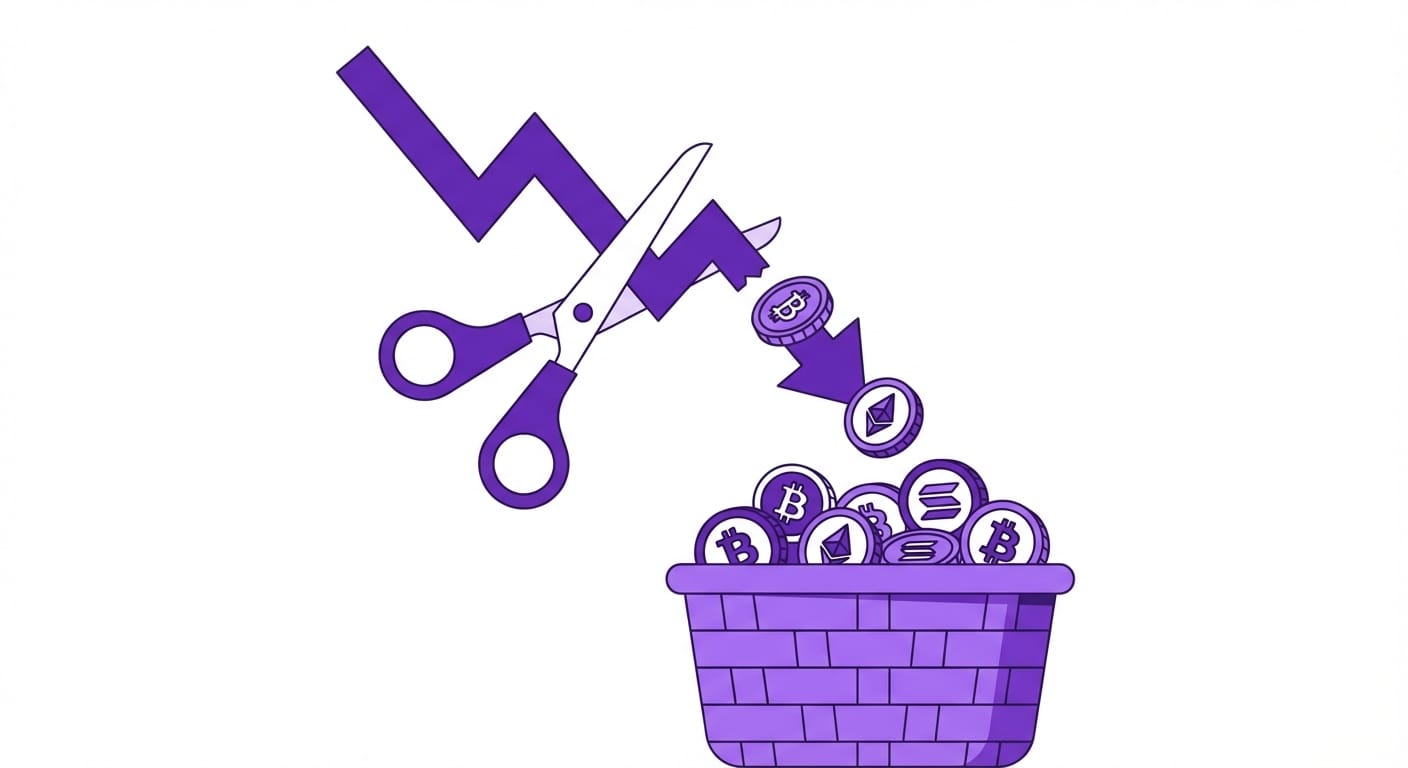
Tax loss harvesting is a strategy in which you deliberately sell positions that are at a loss, in order to "harvest" that loss and use it as a deduction against realized gains. The net effect: a lower taxable capital gain, and therefore less tax.
The concept is widespread in countries with a capital gains tax on investments. In the US, it is standard practice. In Belgium, it was until recently irrelevant for the average investor, precisely because there was no tax on capital gains within normal management. That has now changed.
Why is this becoming relevant for Belgian crypto investors?
Under the new regime, capital gains on crypto are taxed at 10%, with an annual exemption of €10,000. Importantly, the law explicitly provides for the deductibility of capital losses. You may offset a realized loss on crypto against realized gains on other financial assets (shares, ETFs, gold, and so on), as long as both fall within the same calendar year.
There are two crucial limitations. First, losses cannot be carried forward to future years. Whatever you do not offset in 2026 is lost. Second, only capital losses that arise after the snapshot moment of 31 December 2025 count. Historical losses from before that date are not deductible. The legal basis is now final: the Chamber approved the law on 3 April 2026 and it was published in the Belgian Official Gazette on 21 April 2026 as the Law of 6 April 2026, applicable retroactively since 1 January 2026.
Why crypto is particularly well suited
On the BEFire subreddit, there is already lively discussion about tax gain and tax loss harvesting in the context of ETFs and shares. There you quickly run into practical hurdles: the stock exchange tax (TOB) of 0.12% to 1.32%, broker fees, and the limited trading hours of traditional exchanges.
Crypto barely has those hurdles. Transaction costs on an exchange like Bitvavo are around 0.15% to 0.25%. There is no TOB on crypto. The market is open 24/7. And most importantly: you can sell a position and buy it back immediately without any waiting period or meaningful additional cost.
That makes crypto a particularly efficient vehicle for tax loss harvesting. The friction costs are minimal compared to traditional investments.
How would it work in practice?
Imagine: it is December 2026. Over the course of the year you have sold a number of crypto positions with a total capital gain of €14,000 (calculated from the snapshot value of 31 December 2025). After deducting the €10,000 exemption, you would pay 10% on €4,000, so €400 in tax.
But you also have an altcoin in your portfolio that is deeply underwater. The snapshot value on 31 December 2025 was €3,000, the current market value is €1,200. If you sell that position before 31 December 2026, you realize a capital loss of €1,800. Your net taxable capital gain then drops to €14,000 minus €1,800 = €12,200. After the exemption, you pay 10% on €2,200, so €220. A saving of €180.
Do you still want to keep holding that altcoin? Then you buy it back right after the sale. You have harvested the loss for tax purposes, but your position in the market is unchanged. The new purchase price becomes your new cost basis for future calculations.
The big unknown: wash sale rules
In many countries (notably the US) there are so-called wash sale rules that target exactly this scenario. If you sell an asset and buy it back within 30 days, the loss is not recognized for tax purposes. The Law of 6 April 2026 contains no explicit wash sale rule for financial assets. That does not mean the risk is zero. In theory, the tax authorities could argue that a sale and immediate repurchase is not a genuine transaction but a tax-driven construction, especially if there is no further economic rationale behind it.
Here we are entering uncharted territory. There is no ruling, no circular, and no case law on tax loss harvesting in combination with the new Belgian capital gains tax. Let alone specifically for crypto. It is a thought experiment based on the available legal texts, not tax advice.
The interplay with the exemption
The €10,000 exemption makes the strategy extra interesting. If your total net capital gain (gains minus losses) stays below €10,000, you simply pay nothing. Tax loss harvesting can therefore help you stay just under that threshold.
Conversely: if you have not realized any noteworthy capital gains in a given year, there is no point in harvesting losses. After all, you cannot carry those losses forward to the next year. Timing is everything.
Unused exemption can be carried forward to a limited extent: up to €1,000 per year, with a maximum of €15,000. That is a small but relevant detail for anyone spreading their capital gains over several years.
Cross-asset offsetting
A particularly powerful aspect of the law: capital losses on crypto may be offset against capital gains on all financial assets, and vice versa. A loss on an altcoin can therefore be deducted from the gain on the sale of shares or an ETF. That cross-asset offsetting opens up possibilities for integrated portfolio management that simply did not exist before.
What does this mean for your portfolio bookkeeping?
Tax loss harvesting requires accurate bookkeeping. At any given moment you need to know which positions are at a gain and which are at a loss, calculated from the correct cost basis (the weighted-average snapshot value for pre-2026 assets, the purchase price for assets bought after 1 January 2026). The law does not impose FIFO here: pre-2026 holdings get a weighted-average acquisition value per asset, and for later purchases Cryptotax uses chronological FIFO bookkeeping as the most defensible approach.
A tool like Cryptotax calculates this automatically. Your portfolio snapshot shows your unrealized gains and losses per asset at any moment, so that at the end of December you can make a well-considered decision about which positions you might want to sell for tax optimization.
In summary
Tax loss harvesting was a theoretical concept in Belgium until now. With the introduction of the 10% capital gains tax, it becomes practically relevant for the first time. Thanks to low transaction costs, the absence of TOB, and 24/7 market access, crypto is a particularly suitable instrument for applying this strategy.
But let it be clear: this remains partly a thought experiment. The law has now been definitively approved and published, but there are still no rulings or official positions on tax loss harvesting under the new regime. And the question of whether the tax authorities would consider an immediate repurchase to be abuse remains entirely open. Always consult your accountant or tax advisor before making tax decisions.
What is certain: those who have their crypto bookkeeping in order are best positioned. Regardless of how the practical application develops further.
This article is not tax advice. Cryptotax informs based on the published legal text and public sources. Consult your accountant or tax advisor for an interpretation of your specific situation.