
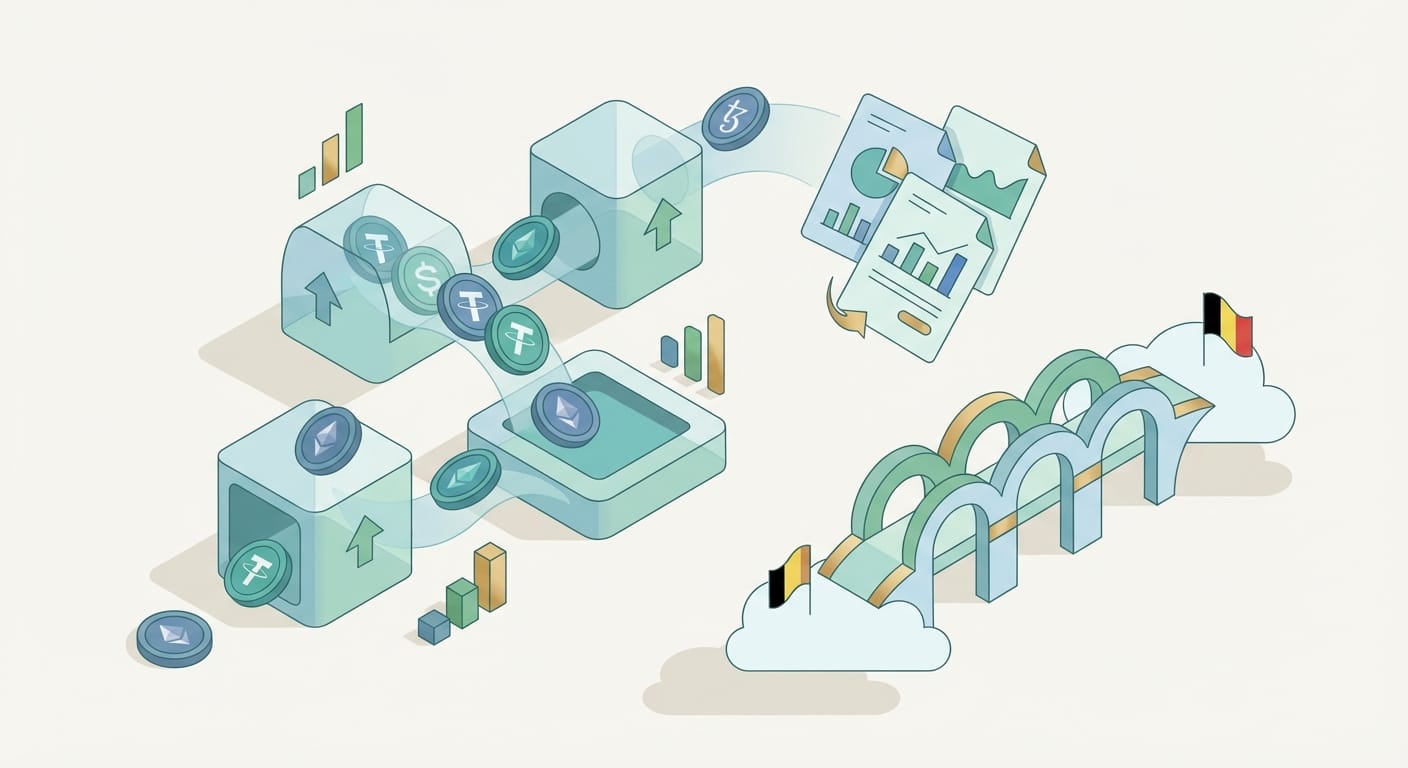
When is stablecoin yield taxed in Belgium? A practical guide to USDC, USDT, lending, auto-compounding and incentives.
Last updated: March 2026
You have 10,000 USDC or USDT sitting on an exchange or in a wallet. You want to earn a return on it through Aave, Morpho, Moonwell or an auto-compounding vault. The question is not only "what does it yield?", but also: when is stablecoin yield taxed in Belgium?
That is exactly where things often go wrong. Many Belgian investors understand that staking or airdrops can be taxable, but underestimate how quickly "cash management" with stablecoins also has tax consequences. As soon as you receive interest, claim rewards, earn fees or your position grows in some other way, the tax authorities no longer look only at the fact that you hold a stablecoin.
In this article we explain step by step how Belgian crypto investors should look at USDC, USDT, stablecoin interest, lending, auto-compounding, incentives and bridging. The goal: a simple decision framework that tells you what is taxable, when, and which supporting documents you need to keep.
The short version
- Simply holding stablecoins does not by itself create a separate income moment
- Lending out stablecoins or depositing them in a vault is generally not the taxable moment in itself
- The interest, yield or rewards you receive are generally taxable income
- Auto-compounding changes nothing about this: even without a manual claim, the return can be taxable
- Borrowing USDC or USDT against collateral is in principle not income, but the interest costs and later disposals do count
- Bridging between chains is usually not a taxable sale, but fees and cost basis remain important
1. What do we mean by stablecoin yield?
By stablecoin yield we mean any way in which you try to earn a return from stablecoins such as USDC or USDT. That can happen in various ways:
- You lend out USDC through a protocol such as Aave
- You deposit stablecoins in a vault such as Morpho or Mamo
- You use a protocol such as Moonwell to receive supply interest and incentives
- You receive extra protocol tokens on top of your interest
- You move stablecoins between chains to get higher yields or lower fees
Economically this resembles "cash management": you park liquidity and expect a relatively predictable return. But for tax purposes this is not a savings account. The way the protocol pays out your return also determines how you have to document it.
2. Is holding USDC or USDT taxable?
Merely holding a stablecoin is usually not a separate taxable income moment. After all, you are not yet receiving any interest or reward. You simply own a digital asset.
That does not mean stablecoins are tax-irrelevant. Even with USDC or USDT you still have to preserve the historical context: when did you buy them, at what value, with what costs, and what did you later do with them?
As long as the peg stays intact, the price difference is often limited. But the tax authorities ultimately look at transactions and returns received, not at the marketing label "stablecoin". In the event of a depeg or a later swap/sale, tax consequences can certainly arise.
3. When is stablecoin lending taxed?
The deposit itself into a lending protocol is generally not the moment at which you realize income. In many cases you exchange USDC for a representative token or vault share that continues to track the same economic position.
Where the tax focus does begin is with the return:
- Interest that accrues periodically
- Vault shares that rise in value
- Rebasing tokens whose balance automatically increases
- Protocol rewards or incentive tokens
That is the core of the difference between "I moved USDC" and "I received a return". Anyone who confuses the two risks filing an incorrect return. This follows the same logic we also explain in our guide on when you have to declare crypto.
4. Auto-compounding: taxable even without a payout?
Yes, that is precisely one of the trickiest points.
With classic interest you think of a payout into your account. But in DeFi your position often grows without an explicit payout:
- your balance rebases automatically
- your vault share becomes worth more
- your return is immediately reinvested
From a tax standpoint, the return does not disappear because of this. It is just packaged differently in technical terms. That is why it is not enough to look only at withdrawals. You have to be able to demonstrate which part of a later withdrawal is your original principal and which part constitutes return.
That is also why protocol-specific articles such as Aave, Morpho and Mamo are useful, but not sufficient if you as a user combine multiple products.
5. What if you borrow USDC against ETH or BTC?
Many investors do more than just lend out. They also use ETH, BTC or cbBTC as collateral to borrow USDC for extra liquidity.
In principle, receiving a loan is not income. You are not paid any profit; you take on an obligation to repay later. But there are some tax points to watch:
- you have to document interest costs and protocol fees separately
- liquidations can in fact trigger a taxable moment
- spending with borrowed stablecoins can later lead to new taxable transactions
A common mistake is to think that "borrowing stablecoins" automatically means tax-free across the entire chain of events. That is not correct. The loan itself is something other than the costs, incentives, liquidations and later disposals that arise from it.
6. Are incentive tokens and extra rewards taxable separately?
Yes. In addition to the base interest, many protocols pay out extra rewards in a governance or incentive token. Think of WELL, MORPHO or other bonus mechanisms.
Even if you initially came only for "safe" stablecoin yield, those extra rewards change your file. You then receive not only interest on USDC or USDT, but also a separate token with its own market value at the moment of claim or receipt.
For the tax authorities, that is a separate stream that you have to value and document separately. We saw this earlier with broader categories such as staking, capital gains and airdrops.
7. What about bridging between Ethereum, Base and Arbitrum?
Many users first send their stablecoins to another chain to earn a higher return there. For example: bridging USDC from Ethereum to Base or Arbitrum, and then on to Aave, Morpho or Moonwell.
Bridging itself is generally not a taxable sale if you are essentially moving the same economic position. But two things remain crucial:
- fees have to be included correctly
- cost-basis continuity has to be preserved across chains
Anyone who is careless about that will later see an incorrect result in FIFO calculations. You can read more about that mechanism on our page about DeFi positions and valuation and in our explanation of cost basis and FIFO.
8. Practical decision tree: what is taxable and when?
| Action | Typical tax reading | What do you need to keep? |
|---|---|---|
| Simply holding USDC or USDT | No separate income moment | Purchase date, quantity, cost price |
| Depositing USDC into Aave or Morpho | Deposit itself generally not income | Tx hash, deposited amount, position token or share received |
| Interest or yield accrues | Generally taxable income | Timestamp, EUR value, protocol report or on-chain evidence |
| Claiming an incentive token | Separately taxable income | Claim moment, token quantity, EUR value |
| Borrowing USDC against collateral | Loan itself generally not income | Loan tx, collateral, interest costs, later repayment |
| Bridging USDC to another chain | Usually no realization | Source tx, destination tx, bridge fees |
| Withdrawing from a vault or lending position | Split between principal and return | Original deposit, withdrawal, accrual, EUR valuation |
9. Which supporting documents do you need to keep?
With stablecoin yield, supporting documents are even more important than with a simple spot trade. Your file often contains small returns over long periods, across multiple chains and protocols.
So at a minimum, keep:
- the transaction hashes of deposits, claims, withdrawals and bridges
- an overview of your wallet addresses and which ones belong to you
- the EUR value of returns at the moment of receipt or claim
- screenshots or exports of protocol dashboards as extra context
- a transparent report in which principal and return are kept separate
Our guide on supporting documents for your crypto tax return goes into this in more depth.
10. The most important mistake Belgian investors make
The biggest mistake is treating stablecoins as if they are just "digital cash" with no tax nuance. As soon as you start seeking a return, you shift from simply holding to a series of taxable or evidence-sensitive events:
- interest accrues
- rewards are claimed
- shares rise in value
- USDC moves across chains
- loans and liquidations come into play
In other words: the risk profile may feel lower than with volatile altcoins, but the administrative and tax profile often becomes more complex precisely because of this.
Conclusion
Stablecoins are not a blind spot in your tax return. Anyone who uses USDC or USDT for lending, yield or treasury-like cash management will face several tax moments: interest, incentives, bridging, cost basis and sometimes also liquidations.
The rule of thumb is simple: the deposit is rarely the whole story. Above all, you need to know where the return arises, how it appears in technical terms, and how you keep principal and income separate.
Do you use several protocols at the same time? Then it pays off to have your full activity reconstructed in a consistent file. Start for free with CryptoTax and see how your stablecoin returns, rewards and cross-chain flows automatically end up in a Belgian report.
Disclaimer: this article is purely informational and not individual tax advice. For specific files or borderline cases, we recommend consulting a Belgian tax specialist.