
The era of fiscal uncertainty for Belgian crypto investors is largely behind us. Where we previously often found ourselves in a grey area between the "normal management of private assets" (…
The era of fiscal uncertainty for Belgian crypto investors is largely behind us. Where we previously often found ourselves in a grey area between the "normal management of private assets" (tax-free) and "speculation" (33% tax), the Law of 6 April 2026 brings clarity, but also new obligations. The law was approved by the Chamber on 3 April 2026, published in the Belgian Official Gazette on 21 April 2026, and applies retroactively from 1 January 2026. The core? A flatter 10% capital gains tax on crypto assets.
To determine the exact amount on which you owe that 10% tax, you need to know precisely what your cost basis (acquisition value) is. Contrary to what is often claimed, the law does not impose FIFO: for crypto you already held before 2026, a weighted average acquisition value per asset applies (art. 102 §4 ITC 92). For lots you buy from 2026 onwards, the law sets no order; a chronological record using the FIFO method (First In, First Out) is the most defensible approach, and that is what Cryptotax uses. At first glance this seems simple, but for anyone who trades regularly or is active on several platforms, it quickly becomes an administrative labyrinth. In this article we explain how to perform this calculation correctly and how Cryptotax fully automates the process for you.
What is the 'Cost Basis' and why is it crucial for your return?
The cost basis (in Dutch the aanschaffingswaarde) is simply the amount you originally paid for your coins, including transaction costs. This figure is essential because the Belgian tax authorities do not look at your total turnover, but at your realised capital gain.
The formula is simple:
Sale price − Acquisition value = Taxable capital gain
Suppose you bought 1 BTC for €30,000 and later sell it for €50,000. Your capital gain is then €20,000, on which you pay 10% tax, so €2,000 (before applying the exemption, see below).
This profit must be reported in your personal income tax. For most investors this happens under the new capital gains tax on crypto (2026 regime). Anyone who declares the profit as miscellaneous income (diverse inkomsten) due to speculation uses box XV; for professional activities, the professional income in box XVII applies.
Have you incurred losses? Then the cost basis matters just as much. Under certain conditions you can offset losses against gains from the same year, which lowers your overall tax burden.
Which method applies in Belgium?
Several methods exist to determine which coins you sell "first" when you have made multiple purchases:
- FIFO (First In, First Out): The first coins purchased are sold first.
- LIFO (Last In, First Out): The most recently purchased coins are sold first.
- HIFO (Highest In, First Out): The most expensive coins are sold first.
- Average cost: You use the weighted average purchase price of all your coins.
Contrary to what is often claimed, the Law of 6 April 2026 does not prescribe FIFO. The law does explicitly regulate your pre-2026 holdings: all units of an asset that you held on 31 December 2025 together receive a single weighted average acquisition value (by default the market value on the reference date, or on request the actual average purchase price via the latent-loss exception). For lots you buy from 2026 onwards, the law sets no selling order.
So why does Cryptotax opt for FIFO for those post-2026 lots? Because the method is objective and unambiguous. There is no room for strategically choosing which "lot" you sell to optimise your tax. FIFO provides a consistent and verifiable trail that both the taxpayer and the tax authorities can follow.
This has an important consequence: in a rising market, FIFO generally leads to a higher taxable capital gain, because your oldest (and often cheapest) coins are sold first. That makes it all the more important to keep your records in order.
Step by step: how do you calculate FIFO?
Step 1: Gather your complete transaction history
The basis of every FIFO calculation is a complete overview of all your purchases and sales. This includes:
- Exchange exports: Download your transaction history from platforms such as Bitvavo, Kraken, Binance or Coinbase.
- On-chain transactions: Transactions via DeFi protocols, DEXes or directly from your wallet are not always recorded by an exchange. You have to retrieve these separately via the blockchain.
- OTC purchases: Did you buy crypto via a peer-to-peer transaction? Keep the proof of payment.
Step 2: Determine the euro value at the moment of the transaction
Every transaction must be valued in euros at the exact moment it took place. This applies to both purchases and sales. If you bought BTC with ETH (a crypto-to-crypto transaction), you need to know the euro value of both sides of the transaction at that moment. A crypto-to-crypto swap is treated for tax purposes as a sale of one coin followed by a purchase of the other.
Step 3: Include transaction costs
Transaction costs (fees) increase your acquisition value. If you buy 1 ETH for €3,000 and pay €15 in fees, then your cost basis is €3,015, not €3,000. On a sale, fees reduce your net proceeds. This works in your favour: higher costs mean a lower taxable capital gain.
Also do not forget the gas fees on on-chain transactions. These network costs likewise count towards your cost basis.
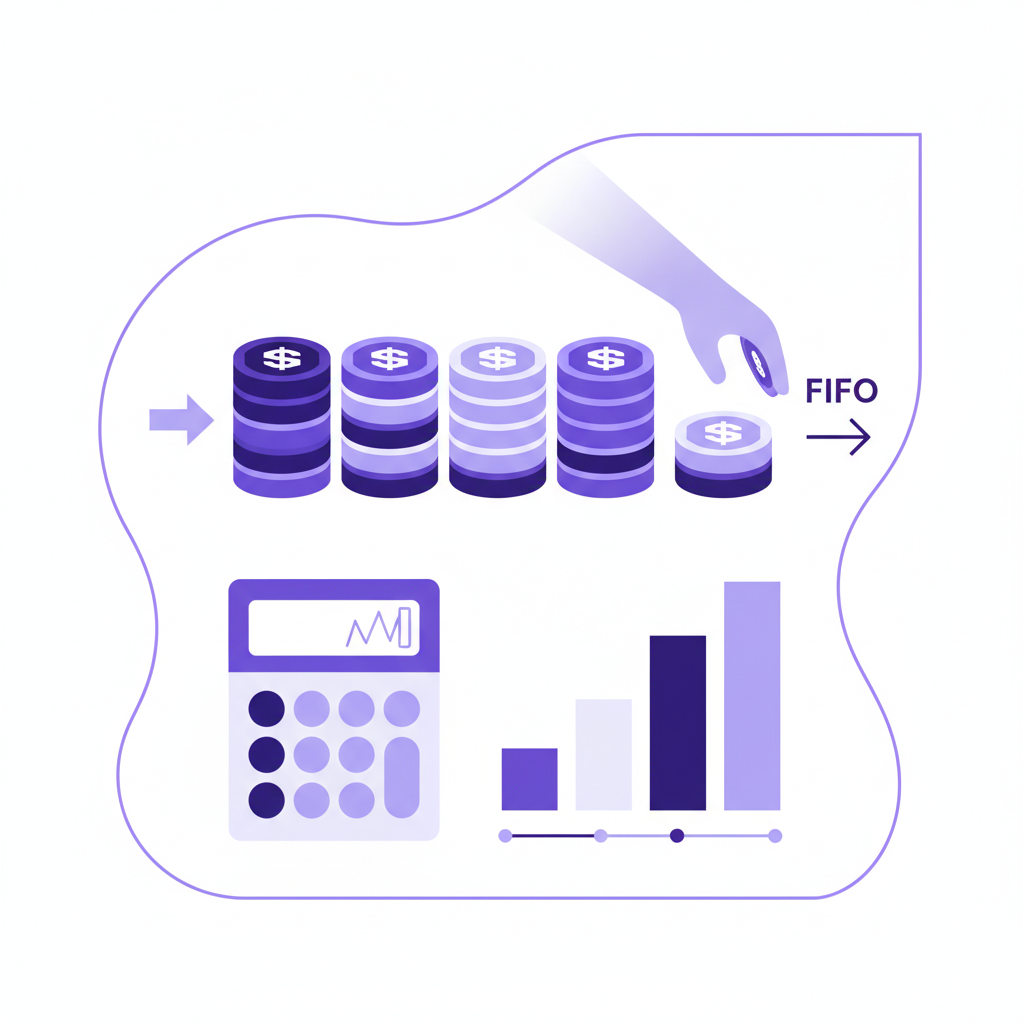
Step 4: Apply the FIFO method
When you sell, you match the sold coins to your oldest outstanding purchases. You work through a queue, as it were: the first coin that went in is the first to come out.
A concrete scenario: FIFO in practice
Let us illustrate this with a realistic example. Suppose you made the following Bitcoin transactions in 2026:
| Date | Action | Quantity | Price per BTC | Total amount |
|---|---|---|---|---|
| 15 January 2026 | Purchase | 0.5 BTC | €40,000 | €20,000 |
| 10 March 2026 | Purchase | 0.3 BTC | €50,000 | €15,000 |
| 20 June 2026 | Sale | 0.6 BTC | €60,000 | €36,000 |
You sell 0.6 BTC on 20 June. How do you determine the cost basis with FIFO?
Step 1: The oldest purchase is allocated first. You have 0.5 BTC from 15 January → these are sold in full.
Cost basis for these 0.5 BTC: €20,000
Step 2: There is still 0.1 BTC left to allocate (0.6 − 0.5 = 0.1). These come from your next purchase of 10 March.
Cost basis for these 0.1 BTC: 0.1 × €50,000 = €5,000
Total cost basis: €20,000 + €5,000 = €25,000
Sale proceeds: 0.6 BTC × €60,000 = €36,000
Taxable capital gain: €36,000 − €25,000 = €11,000
Tax due (10%): €1,100
After this sale you still have 0.2 BTC left from your March purchase (0.3 − 0.1 = 0.2 BTC), with a cost basis of €10,000. These form your "stock" for future sales.
The role of DAC8 and the Belgian tax authorities
Anyone who thinks the tax authorities cannot check how much crypto you hold should take the DAC8 directive into account. This European directive requires crypto platforms to automatically share their users' transaction data with the tax authorities of EU member states.
In concrete terms, this means:
- Exchanges such as Bitvavo, Binance and Coinbase report your purchases and sales to the Belgian tax authorities.
- The reporting includes transaction amounts, dates and wallet addresses.
- Data collection has been running since 1 January 2026; the first exchange with the Belgian tax authorities follows in September 2027.
This makes manual spreadsheets increasingly risky. A small error in your calculation or a forgotten transaction can lead to a discrepancy between your return and the data the tax authorities hold. The consequences? Possible fines and a correction of your tax assessment.
Exemptions and nuances
The €10,000 exemption
The law provides for an annual exemption of €10,000 per taxpayer on capital gains from financial assets (including crypto). This means you only pay tax on the portion of your profit that exceeds this threshold.
In our example above, the capital gain was €11,000. After deducting the exemption, you pay tax on only €1,000: €100 instead of €1,100.
The TOB does not apply
A frequently asked question: do you have to pay the tax on stock-exchange transactions (TOB) when buying and selling crypto? The answer is no. The TOB only applies to transactions in regulated financial instruments (shares, ETFs, bonds). Cryptocurrencies do not fall under this.
The challenge of complex portfolios
The FIFO calculation becomes considerably more complex when your portfolio involves more than simple purchases and sales:
Airdrops and hard forks
If you receive free tokens via an airdrop or a hard fork, the cost basis is usually €0 (or the market value at the moment of receipt, depending on the tax treatment). This means that on a sale almost the entire proceeds are taxed as a capital gain.
Staking rewards
Rewards from staking are valued at the market value applicable at the moment of receipt. This amount forms your cost basis. If you later sell at a higher price, you only pay tax on the difference.
Transfers between your own wallets
A transfer from your Binance account to your Ledger hardware wallet is not a taxable event. After all, no sale takes place. But, and this is crucial, you must correctly "carry over" the cost basis to the new location. If you do not track this accurately, you lose the FIFO trail and your calculation becomes unreliable.
DeFi transactions
Liquidity pools, yield farming and lending protocols often generate dozens of micro-transactions. Each of these transactions has tax implications and must be correctly included in your FIFO calculation. Keeping track of this manually is in practice almost impossible.
Automate your return with Cryptotax
It should be clear: a correct FIFO calculation requires watertight records of every transaction, on every platform, with the correct euro value at the right moment. For anyone who makes more than a handful of transactions per year, this is virtually unfeasible by hand.
Cryptotax automates this entire process:
- Automatic import: Connect your exchanges (Bitvavo, Kraken, Binance, Coinbase and more) and wallets (Ethereum, Base, Arbitrum). All your transactions are imported automatically.
- Lot calculation: Our engine automatically applies a chronological FIFO record to all your transactions, across all platforms, with the weighted average for your pre-2026 holdings as prescribed by the Law of 6 April 2026.
- DeFi support: Staking, swaps, bridges, lending, Cryptotax automatically recognises and categorises complex DeFi transactions.
- Tax report: Generate a ready-to-use overview that you can directly use for your tax return, including the calculation for Annex 2.
Whether you are a beginning investor with a few transactions or an experienced DeFi user with thousands of transactions spread across multiple blockchains, Cryptotax ensures that your calculation is correct and that your return is complete.
Conclusion: preparation is half the work
The 10% capital gains tax on crypto assets marks a new chapter for Belgian crypto investors. The law has applied since 1 January 2026, and thanks to DAC8 the tax authorities are gaining more and more insight into your crypto transactions.
The key to a correct and advantageous return? An accurate cost basis calculation: the weighted average for your pre-2026 holdings and an airtight chronological record for everything thereafter. Start getting your transaction history in order today. And if you want to make it easy on yourself, let Cryptotax do the calculations for you.