
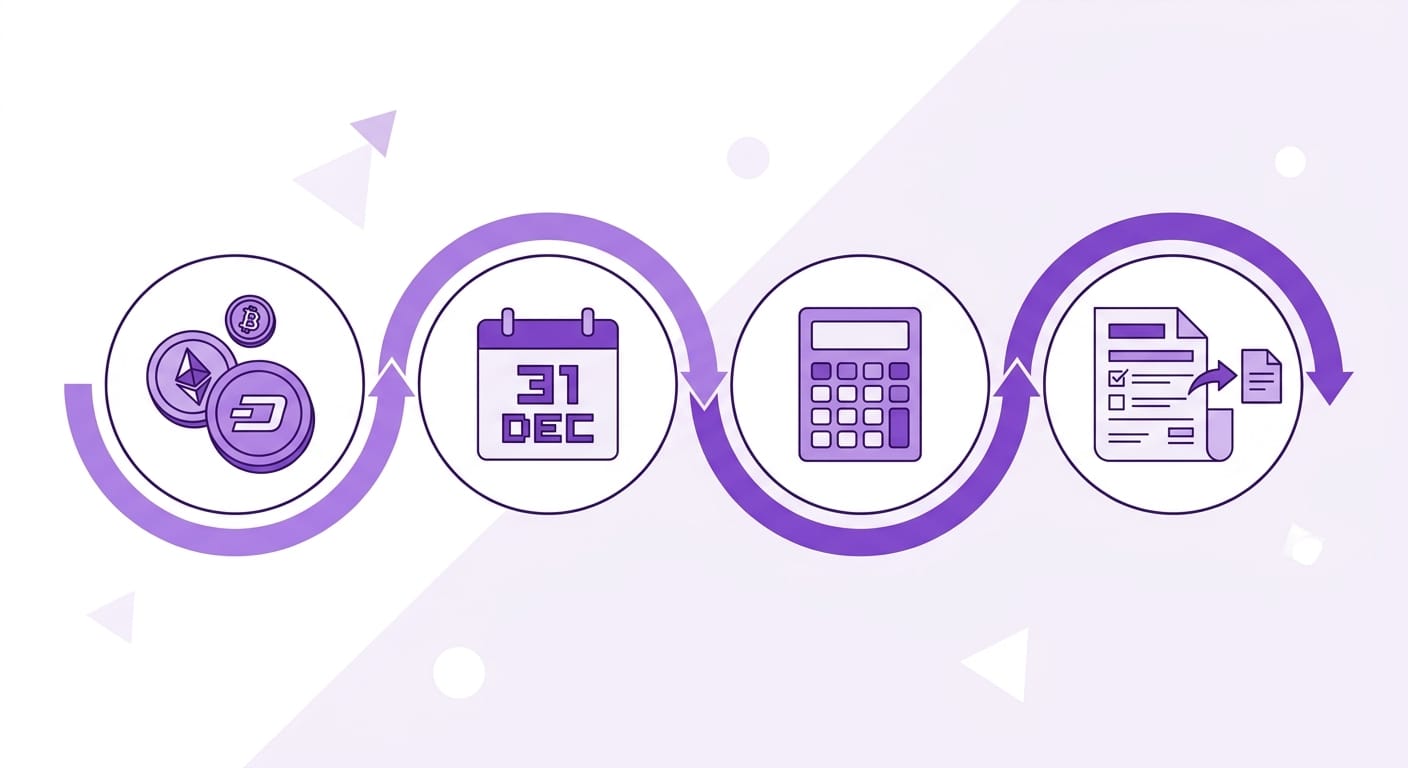
The first crypto tax return under the new 10% capital gains tax. The 4-step plan: portfolio snapshot, FIFO matching, exemption, and Tax-on-Web.
Published: 9 May 2026 · Reading time: 7 minutes
You file your crypto tax return for income year 2026 in 2027. It is the first return under the new 10% capital gains tax (meerwaardebelasting). There is no historical precedent to fall back on, no sample returns from the tax authority, and the first DAC8 crypto statements from exchanges arrive in September 2027, the same window as your filing deadline. This guide walks through the exact 4-step plan, including what you can prepare right now so that filing day in 2027 becomes a formality.
The law was passed on 3 April 2026 by the Chamber of Representatives and applies retroactively from 1 January 2026.
🎯 The short version (TL;DR)
- Step 1: freeze your portfolio on 31/12/2025 (reference date, do this now).
- Step 2: record every 2026 disposition with FIFO matching against your step-up or post-2026 cost basis.
- Step 3: sum the net capital gains (meerwaarde), subtract the €10,000 exemption, calculate 10%.
- Step 4: report via Tax-on-Web (Vak XV or the specific capital-gains code) and register foreign accounts via the Central Point of Contact (CAP).
- The return itself is filed between May and October 2027. Start Step 1 before any 2026 transactions accumulate that you would later have to reconstruct.
📅 Step 1: Freeze your portfolio on 31 December 2025
The snapshot moment is in the past: at 23:59 UTC on 31/12/2025 you held a specific EUR value per token. That value becomes your step-up cost basis for pre-2026 holdings. If you have not taken a snapshot yet, you can reconstruct it retroactively, but that task grows exponentially harder as time passes and exchanges shorten their retention periods.
What to document per platform
- Centralised exchanges (Bitvavo, Kraken, Binance, Coinbase): download your portfolio snapshot or account statement for 31/12/2025 as a PDF, plus the full CSV history up to that date.
- Self-custody wallets (Ledger, MetaMask, Rabby): export the transaction history per chain and verify the closing balance on a block explorer (Etherscan, Arbiscan, Basescan) around 23:59 UTC on 31/12/2025.
- DeFi positions: document the underlying values for staking, lending, and liquidity pools. Yield-bearing tokens such as stETH, aTokens, or Morpho vault tokens carry a price that deviates from the spot price.
- EUR price per token: use two independent sources (CoinGecko historical close price and the exchange closing rate).
For the full checklist, see our step-up rule explanation with the documentation checklist.
🧮 Step 2: Match every 2026 disposition with FIFO
A disposition is any event in which you convert crypto into something else: a sale to EUR, a swap to another token, a payment in crypto, or the purchase of an NFT with ETH. For income year 2026 you must match each disposition against your oldest open purchase (FIFO).
Three cost-basis scenarios
- Pre-2026 holding: cost basis = step-up value on 31/12/2025 (or the unrealised-loss exception if your actual purchase price was higher).
- Post-2026 purchase: cost basis = actual EUR purchase price including gas fees and exchange commissions.
- Crypto received as income (staking, mining, airdrop): cost basis = EUR market value at the moment of receipt, even if that was in 2026.
FIFO order applies from 1 January 2026. For pre-2026 lots the law uses the weighted-average purchase price when you invoke the unrealised-loss exception. Read our FIFO calculation guide for edge cases.
Concrete examples of a disposition
- Sell 0.5 BTC to EUR on Bitvavo → taxable.
- Swap 1 ETH for 3,000 USDC on Uniswap → taxable (both the ETH disposition and the USDC acquisition).
- Payment of EUR 5,000 in USDT for a service → taxable.
- Stake ETH via Lido → not taxable (no disposition, only a wrap), but stETH rewards are income.
- Bridge ETH from mainnet to Base via Across → fiscally neutral for a 1:1 bridge, but routing through a swap aggregator creates two taxable events.
💰 Step 3: Calculate your net capital gains and apply the €10,000 exemption
Add up all 2026 capital gains. Losses may be offset within the same year, but cannot be carried forward to 2027. Then subtract the annual exemption of €10,000 per person. Multiply whatever remains by 10%.
Example 1: small gain, no tax
| Step | Amount |
|---|---|
| Gross capital gains 2026 | EUR 8,500 |
| Exemption | EUR 10,000 |
| Taxable | EUR 0 |
| Tax due | EUR 0 |
With this profile you still report your capital gains and cost basis. Unused exemption above EUR 5,000 may be carried forward for up to 5 years.
Example 2: medium-sized gain
| Step | Amount |
|---|---|
| Gross capital gains 2026 | EUR 17,500 |
| Exemption | EUR 10,000 |
| Taxable | EUR 7,500 |
| Rate | 10% |
| Tax due | EUR 750 |
Example 3: mixing gains and losses
| Step | Amount |
|---|---|
| Gains on 7 dispositions | EUR 22,000 |
| Losses on 4 dispositions | EUR 6,000 |
| Net 2026 | EUR 16,000 |
| Exemption | EUR 10,000 |
| Taxable | EUR 6,000 |
| Tax due | EUR 600 |
The EUR 6,000 in losses may only be offset in 2026. They cannot be carried forward to 2027 or later.
📝 Step 4: Complete your return and register foreign accounts
The return for income year 2026 is filed in 2027. Tax-on-Web normally opens at the end of April 2027, with deadlines falling between June and October depending on your profile.
Where do you enter your crypto capital gains?
- Normal management (10% capital gains tax): in the specific crypto capital-gains code introduced with the law. At the time of writing (May 2026) the exact code has not yet been definitively published; FPS Finance (FOD Financiën) will communicate this in Q4 2026.
- Speculative trading (33%): Vak XV, code 1440-15 for the gross amount, code 1441-14 for costs. With a mixed profile, parts of your portfolio can fall under different regimes.
- Professional activity (progressive rate up to 50%): Vak XVII (profits and earnings), with social contributions via your social insurance fund.
For a step-by-step walkthrough, read our Tax-on-Web guide.
Foreign exchange accounts: dual reporting obligation
For every foreign exchange account (Kraken in the US, Binance in Malta, Bitvavo in the Netherlands, Coinbase in Ireland) you have two reporting obligations:
- CAP registration: register once (and upon any change) with the Central Point of Contact (CAP) at the National Bank of Belgium. Read the Kraken CAP guide and the CAP checklist.
- Return Vak XIII: in every annual tax return you tick the box indicating you hold a foreign account and provide the country and institution.
Self-custody wallets (Ledger, MetaMask) are not subject to the CAP reporting obligation because there is no intermediary. Read the CAP filing guide for the full scope.
🛠️ How Cryptotax automates this
The manual version of the 4 steps above is feasible for one exchange and a handful of dispositions. For a mixed portfolio with DeFi, cross-chain bridges, and staking it quickly becomes a week of work. Cryptotax handles it in a single pipeline:
- Read-only connections to Kraken, Binance, Bitvavo, Coinbase, Revolut, and EVM wallets (Ethereum, Base, Arbitrum).
- Automatic step-up snapshot per token on 31/12/2025 with an audit trail to the price source.
- FIFO matching per disposition with detection of swaps, bridges, LP events, and staking rewards.
- Classification into crypto capital gains tax (2026 regime) or miscellaneous income/professional income (diverse inkomsten/beroepsinkomsten) (Vak XV/XVII), with a justification per transaction.
- Tax-on-Web export and CAP registration template ready to copy.
Start a free scan. It costs nothing and within 5 minutes you have a first estimate of your 2026 capital gains.
❓ Frequently asked questions
When do I have to file my 2026 crypto return?
Between May and October 2027, depending on your profile (Tax-on-Web or paper, with or without assistance). The exact deadlines will be published in Q1 2027 by FPS Finance.
What if I did not sell anything in 2026 and only held?
No disposition means no capital gains, and no capital gains means no tax. However, you must be able to document your portfolio if the tax authority requests an audit. A return showing EUR 0 capital gains is valid and may be advisable to establish your starting position on record.
Does a swap between two stablecoins (e.g. USDT to USDC) count?
Yes, fiscally this is a disposition of USDT and a purchase of USDC. With a €1 peg the capital gain is usually negligible, but you still report the transaction. Cryptotax registers this automatically.
What if my foreign exchange went bankrupt in 2026?
Documentation remains crucial. A claim on a bankrupt exchange (FTX, Celsius, Mt.Gox claims) has a market value through secondary claims markets. If a distribution occurs in 2027 or later, that distribution becomes a disposition matched against your documentation.
Can my accountant do this for me?
Yes, and it is strongly recommended for portfolios above EUR 50,000 or for complex DeFi activity. Cryptotax exports an accountant-ready PDF and CSV. Find a Belgian crypto accountant via our partners.
What if I discover errors after filing?
You can file a corrective return via Tax-on-Web within the statutory limitation periods (5 years for good-faith errors). A proactive correction can avoid penalties in the event of a DAC8 mismatch in 2027.
📌 Summary
- The return for income year 2026 is filed in 2027 (May through October).
- Step 1: snapshot your portfolio on 31/12/2025 (urgent if not yet done).
- Step 2: record every 2026 disposition with FIFO matching.
- Step 3: calculate net capital gains, apply the EUR 10,000 exemption, 10% tax.
- Step 4: file via Tax-on-Web and register foreign exchanges via CAP.
- Cryptotax automates the entire pipeline and delivers a Tax-on-Web export.
Further reading: the complete Belgian crypto tax guide 2026, the capital gains tax explained, and the step-up rule.
Sources:
- News.belgium.be: introduction of capital gains tax
- FPS Finance: tax return
- NBB: Central Point of Contact (CAP)
Disclaimer: This article is for informational purposes only and does not constitute individual tax advice. The definitive filing codes for the capital gains tax will be announced by FPS Finance in Q4 2026. Consult a recognised Belgian tax adviser for specific cases.