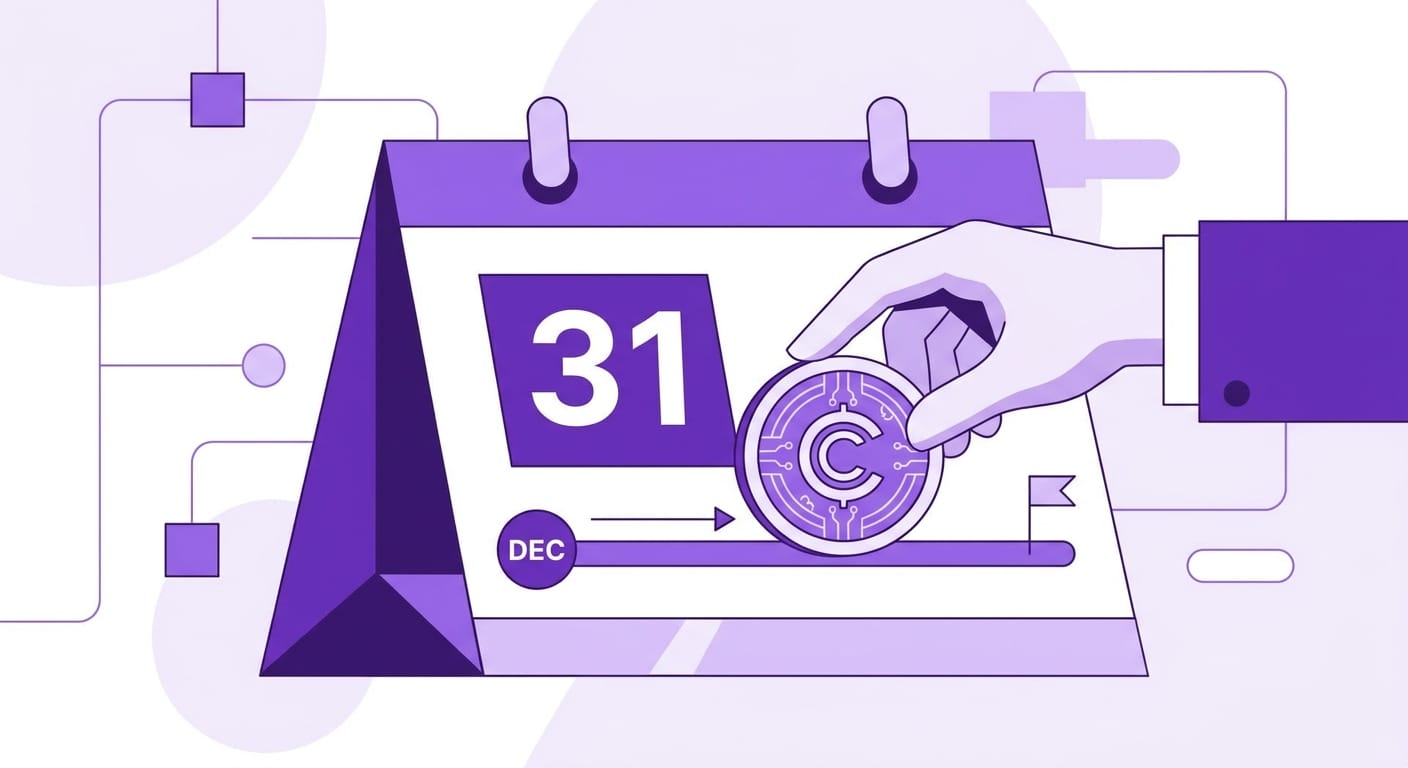
- The market value of your crypto on 31 December 2025 becomes your tax cost basis for the new capital gains tax.
- Gains accrued before 2026 are not taxable as a capital gain, not even retroactively.
- Only the value growth from 1 January 2026 counts towards the 10% capital gains tax.
- Was your crypto under water on the reference date? Then you may use the actual weighted-average purchase price (unrealised-loss exception, transitional arrangement until 31/12/2030).
- Collecting proof is your responsibility. Start now, not only in 2027 when DAC8 reports arrive.
Last updated: 24 May 2026 · Reading time: 9 minutes
On 31 December 2025 a snapshot is taken of your crypto portfolio. The market value of each token on that single day becomes your new tax cost basis from 2026 onwards. Anyone who can document their portfolio well pays 10% only on gains after the reference date. Anyone without proof risks the tax authority falling back on the original purchase price (or, in the worst case, EUR 0). This guide explains the step-up rule in full, with two worked examples, a documentation checklist and the exception for unrealised (latent) losses (see also our pillar guide on the 5-year offset window for unrealised losses that expires on 31 December 2030).
The capital gains tax act was approved on 3 April 2026 by the Chamber of Representatives, published on 21 April 2026 in the Belgian Official Gazette (Belgisch Staatsblad) (Act of 6 April 2026), and applies retroactively from 1 January 2026. The step-up rule is therefore final.
📜 What exactly is the step-up rule?
The step-up rule prevents you from paying tax on increases in value that took place when there was no capital gains tax yet. Concretely: the tax authority takes the market value on 31 December 2025 as the starting point for calculating your capital gain, instead of your original purchase price.
This moment is also known as the snapshot moment: a snapshot of your entire crypto portfolio on the last day of 2025. From 1 January 2026, every euro of value growth above that snapshot counts, and only those euros fall under the 10% capital gains tax (above the annual exemption of EUR 10.000 per person).
The legal basis lies in the Act of 6 April 2026 introducing a tax on capital gains on financial assets (published in the Belgian Official Gazette (Belgisch Staatsblad) on 21 April 2026). The step-up rule sits in art. 102 §4 WIB 92, with the accompanying calculation method being the weighted-average acquisition value per financial asset (art. 102 §1 fourth paragraph WIB 92).
📅 Example 1: a simple sale with step-up
Suppose: you bought 1 BTC in 2017 for EUR 3.000. On 31 December 2025 the average closing price stood at EUR 74.652. On 2 January 2026 you sell for EUR 77.170.
| Step | Amount | Effect |
|---|---|---|
| Sale price (2 Jan 2026) | EUR 77.170 | Taxable event |
| Step-up cost basis (31 Dec 2025) | EUR 74.652 | Deductible |
| Taxable capital gain 2026 | EUR 2.518 | Under the exemption |
| Tax due | EUR 0 | EUR 2.518 falls under the EUR 10.000 exemption |
| Exempt pre-2026 (informative) | EUR 71.652 | Step-up fully protects this increase in value |
Without step-up the capital gain would have been EUR 77.170 − EUR 3.000 = EUR 74.170. Of that, EUR 64.170 above the exemption would be taxable at 10% (EUR 6.417 tax). The step-up rule therefore saves you EUR 6.417 here.
⚠️ Example 2: unrealised (latent) losses, exception to step-up
The step-up rule works both ways. What if your crypto was worth less on the reference date than when you bought it? Suppose: you bought 5 ETH in November 2021 at a peak price of EUR 4.000 per ETH (total EUR 20.000). On 31 December 2025 ETH stood at EUR 2.500 (total EUR 12.500). On the reference date you had an unrealised loss of EUR 7.500.
The act provides an explicit exception for this: if your original purchase price was higher than the market value on 31/12/2025, you may use that higher price as your cost basis, provided you can supply the proof. For crypto that you bought at different times, the weighted average of those actual purchase prices is used as the cost basis per unit (per financial asset, art. 102 §1 fourth paragraph WIB 92).
| Step | Amount |
|---|---|
| Purchase Nov 2021 | 5 ETH × EUR 4.000 = EUR 20.000 |
| Value 31/12/2025 | 5 ETH × EUR 2.500 = EUR 12.500 |
| Sale price in 2027 | 5 ETH × EUR 5.500 = EUR 27.500 |
| Permitted cost basis (unrealised-loss exception) | EUR 20.000 (higher actual purchase price) |
| Taxable capital gain | EUR 7.500 |
Without the exception your taxable amount would be EUR 15.000 (EUR 27.500 − EUR 12.500). The unrealised-loss exception halves the taxable amount here. Important to frame: art. 102 §1 fourth paragraph WIB 92 prescribes that for pre-2026 positions the weighted-average acquisition value per financial asset is used, whether you use the step-up value or invoke the higher actual purchase price. For every crypto that you still held in your portfolio on 31/12/2025, a single average cost basis per unit is therefore calculated across all your pre-2026 lots of that asset. With the step-up that is the market value per unit on 31/12/2025; when invoking the exception it is the weighted average of the actual purchase prices of the pre-2026 lots that you still held on the reference date. The order in which pre-2026 lots are consumed on sale makes no tax difference, because every pre-2026 unit has the same cost basis per unit. Two additional restrictions on invoking it: (1) the higher actual purchase price may only lead to a smaller capital gain, not to a deductible capital loss, if you sell below your actual purchase price you fall back on the step-up value; (2) for pre-2026 positions that you later sell at a loss, the deductible loss is in any case limited to the decrease in value from 1 January 2026 (the decline before the reference date is fiscally invisible).
The transitional period runs through 31 December 2030. After that the option lapses and only the step-up value applies, regardless of your actual purchase price.
📋 Documentation checklist 31/12/2025
The burden of proof lies with you. Anyone without proof of their holdings and the market value on the reference date risks the tax authority falling back on the original purchase price or EUR 0 as the cost basis. Here is the practical checklist.
1. Per central exchange (Kraken, Binance, Bitvavo, Coinbase)
- Download the account statement or portfolio snapshot of 31 December 2025 as a PDF. Keep the file with the original timestamp and exchange logo visible.
- Also export the full transaction history (CSV) up to and including 31/12/2025. Some exchanges only supply history, no snapshot. In that case you reconstruct the closing balance from the transactions.
- Save at least two copies: local disk + cloud (Google Drive, iCloud, your own NAS). The worst-case scenario is a bankrupt or blocked exchange where you can no longer access your data later.
- For the EUR price per token on 31/12/2025, note the closing price via a second independent source (CoinGecko, CoinMarketCap, Messari historical close).
2. Per self-custody wallet (Ledger, MetaMask, Rabby, Trezor)
- Take a screenshot of your wallet balance on 31 December 2025 or as close to it as possible. Show the address, date and time.
- Verify the balance on-chain via a block explorer (Etherscan, Arbiscan, Basescan, Solscan, ...) at the block height around 23:59 UTC on 31 December 2025. Keep the explorer URL as proof.
- Per token, note the quantity and the EUR price on that date. For obscure tokens without a liquid market: document the last known price moment and explain why a value was not representative.
3. Per DeFi position (staking, lending, LP)
- For DeFi staking, lending and liquidity pools the underlying values count. Document per protocol: principal, accrued rewards, LP-token price and pool composition on 31/12/2025.
- Yield-bearing tokens (stETH, cbETH, aTokens, cTokens, Morpho vault tokens, Beefy mooTokens, Mamo vaults) have a different price compared to spot. Use the protocol's own exchange rate or contract call to record the true underlying EUR value.
- For LP tokens (Uniswap V3 NFTs, V2 LP tokens, Curve gauge tokens) you record the quantity pair and the pool totals. Tools such as DeBank and Zapper can help, but keep your own on-chain proof as the primary source.
4. For illiquid or forgotten assets
- Old altcoins, locked staking, vesting NFTs, bankrupt exchanges (FTX, Celsius, Mt.Gox claims): as long as you do not realise them, they have no tax impact in 2026. No disposal = no taxable event.
- Do document them for completeness, though. A claim on a frozen account has a market value (often 5–25% of the nominal value via secondary markets such as Claims Market). That value may become relevant later upon a payout.
5. Finally: the inventory
- Create one master document (Excel, Notion, Numbers) with, per asset: ticker, quantity, location (exchange name or wallet address), EUR price on 31/12/2025, total EUR value, link to the supporting document.
- Version the document (v1.0 on 31/12/2025) and make it write-protected. Later changes are red flags for a tax inspector.
- For large portfolios (>EUR 100.000), consider a notarial attestation or an attestation by a bailiff (proces-verbaal). This is overkill for most investors but provides stronger evidentiary value.
🛠️ How Cryptotax does this automatically for you
Keeping a step-up snapshot manually is feasible for one exchange and one wallet. For a diverse portfolio with DeFi, cross-chain and staking it quickly becomes a full day's work. Cryptotax automates the entire snapshot moment:
- A one-time read-only connection of your Kraken, Binance, Bitvavo, Coinbase, Revolut and wallets on Ethereum, Base and Arbitrum.
- Automatic freezing of the market price per token on 31 December 2025, with an audit trail to the price source.
- Detection and correct valuation of DeFi positions (Aave, Morpho, Lido, EigenLayer, Compound, Beefy, Mamo, Moonwell, Swell, MakerDAO).
- Permanent archive: even in 2030 you can still export your 31/12/2025 snapshot as a PDF, with an integrity hash for the tax authority.
- For the unrealised-loss exception: automatic detection of assets where your actual purchase price was higher, with a button to choose that higher price as the cost basis.
Start a free scan to capture your snapshot moment before the first 2026 disposal affects your tax return.
❓ Frequently asked questions
What if I have no proof of my holdings on 31/12/2025?
Then the tax authority may fall back on the original purchase price (often much lower) or, in the worst case, EUR 0. Start documenting retroactively now via on-chain explorers and exchange history, and record the reconstructed balance and the burden of proof in a dated master document.
Does the step-up rule also apply to stablecoins?
Yes. Stablecoins are ordinary crypto-assets for tax purposes and fall under the same rules. The step-up value is the EUR price on 31 December 2025 (usually close to EUR 1, but not exactly equal: USDC closed on 31/12/2025 at approximately EUR 0,9876). Read our stablecoin tax guide.
Does the step-up also apply to NFTs?
In principle yes, but only for NFTs with an investment or payment function (tradeable on marketplaces such as OpenSea). Pure utility NFTs, art collectibles without a secondary market and domain-name NFTs may fall outside the scope. Read our NFT tax guide for the nuances.
What about crypto I bought in 2026?
For post-2026 purchases your actual purchase price (including gas fees and commissions) simply applies as the cost basis. The step-up no longer plays a role. The act imposes no sale order for those lots; a chronological FIFO record is the most defensible approach for matching sales to purchases, and that is what Cryptotax uses.
If I move to Belgium in 2026 or later, does step-up apply then too?
Yes, a comparable rule: the market value on the day you become a Belgian tax resident is your cost basis. Gains accrued abroad (the Netherlands, France, ...) are not taxable in Belgium. Document your portfolio carefully here too on the residency day.
May I still invoke my actual purchase price after 2030?
No. The unrealised-loss exception expires on 31 December 2030. From 2031 only the step-up value applies, even if your tokens were under water on the reference date. So realise your loss before 2031 if desired, or accept the step-up.
How do I report the step-up on Tax-on-Web?
You do not report the step-up itself as a separate transaction. You only use it as the cost basis when calculating your capital gain. In the tax return you enter the net amount above the exemption per realisation year. Read our guide on how to declare crypto in Belgium via Tax-on-Web.
Does the step-up also work for crypto in a company?
No, for companies a different regime applies (article 3:21 KB/WVV). A company can choose between FIFO, LIFO, individualisation or weighted average, and the snapshot-moment mechanism of the capital gains tax does not apply to corporate income tax.
📌 Summary
- Step-up rule: market value on 31/12/2025 = new tax cost basis for the capital gains tax from 2026.
- For pre-2026 positions the weighted-average acquisition value per financial asset applies (art. 102 §1 fourth paragraph WIB 92), both for the step-up and for the unrealised-loss exception. With the step-up that is the market value on 31/12/2025; with the exception, the weighted average of your actual purchase prices.
- Unrealised-loss exception until 31/12/2030: a higher actual purchase price is allowed, provided it is proven.
- Documentation is mandatory. Use exchange snapshots, on-chain explorers and a master document.
- Cryptotax automates the entire snapshot, including for DeFi positions.
Ready to capture your snapshot moment? Start a free scan. Or read on about the capital gains tax, the EUR 10.000 exemption and the complete 2026 overview.
Sources:
- Income Tax Code 1992 (WIB 92)
- News.belgium.be: introduction of the capital gains tax on financial assets
- The Chamber of Representatives: vote on the bill of 3 April 2026
- Bill DOC 56 1244/001: full text of the capital gains tax act
Disclaimer: This article is purely informational and not individual tax advice. The capital gains tax act was approved on 3 April 2026 and published in the Belgian Official Gazette (Belgisch Staatsblad) on 21 April 2026 (Act of 6 April 2026). Consult a recognised Belgian tax adviser for specific cases.