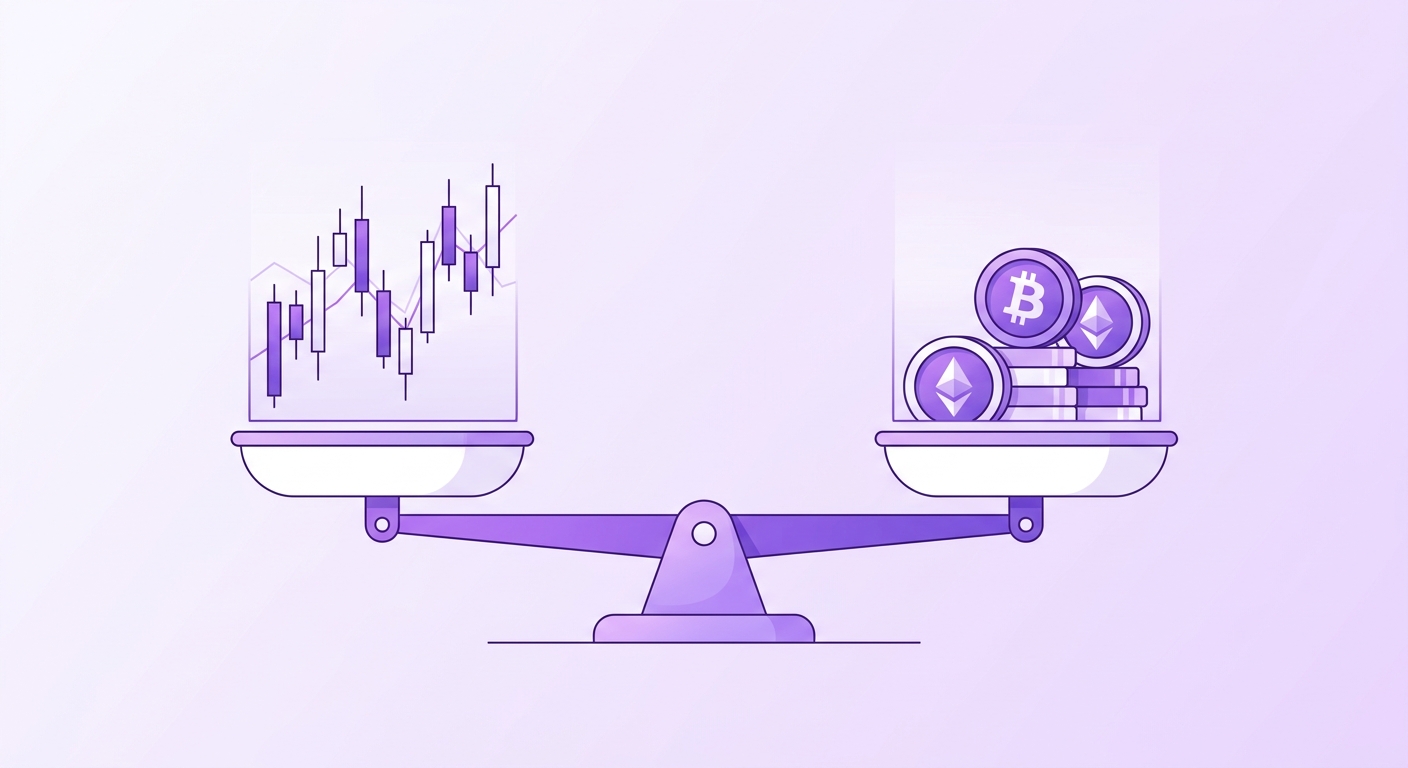
- Leveraged trading on futures and perpetuals almost always falls under miscellaneous income (33% + municipal tax), not under the 10% capital gains tax.
- Liquidations are for tax purposes an ordinary close: losses are deductible in the same year and can be carried forward for 5 years via code 1202/2202.
- Funding fees and exchange fees are deductible as costs via code 1441/2441 under the miscellaneous income regime.
- Cryptotax currently processes Bybit, Hyperliquid and Binance Futures via custom CSV import; native imports are on the roadmap.
- A ruling from the DVB remains the only way to obtain advance certainty about a deviating classification.
Last updated: May 2026 · Reading time: 7 minutes
A Belgian Bybit trader executes 250 perp trades in twelve months. He never holds a position longer than 24 hours. At year end his account shows a PnL of EUR 18.000. His accountant's question: do you pay 10% capital gains tax on this, or 33% miscellaneous income?
The answer is almost always 33%. And that difference, EUR 1.800 versus EUR 5.940, is exactly why this article exists. The new 10% capital gains tax approved in April 2026 applies to those who exercise normal management (private investor) over their private assets. Leveraged trading on futures and perpetuals does not fit that picture. Below we explain why, what tax categories exist for derivatives, how to correctly report liquidations and funding fees, and what you can do today to file correctly.
Three tax categories for derivatives traders
The Belgian tax authority has no separate category for crypto derivatives. You fall under one of three existing regimes, and which one you get depends on how you trade, not what you trade.
| Category | When does this apply? | Rate |
|---|---|---|
| Normal management (private investor) | Practically never for leveraged derivatives | 10% above EUR 10.000 exemption |
| Miscellaneous income (speculative management) | Default for most perp and futures traders | 33% + municipal tax |
| Professional income | Those who make it their primary activity | 25-50% + social contributions |
The good-family-man test determines whether you can remain in the first regime. For derivatives activity that test almost always fails, and that is no coincidence. The Ruling Commission (Dienst Voorafgaande Beslissingen) has always treated leverage as an aggravating factor, and the updated questionnaire from April 2026 has sharpened that position further.
Why leveraged trading is almost always abnormal management
Case law and DVB rulings use five criteria to distinguish "normal management" from speculation. With futures and perpetuals, the average trader scores negatively on virtually every criterion.
- Leverage use. Deploying borrowed capital (3x, 10x, 50x leverage) is, according to established case law, a very strong signal of speculation. A prudent private investor does not borrow money to trade derivatives.
- Short holding periods. Perpetuals are designed for sub-hour to intraday positions. Those who close within days or weeks fall outside "passive investing".
- Transaction frequency. Hundreds of trades per year on one account points to an organised, recurring activity. The DVB threshold of 25% of assets is often exceeded by margin requirements alone.
- Automated or trading-bot setups. Much perp volume runs via API-driven bots or copy-trading. Both count as evidence of speculative intent.
- No underlying ownership. With a perpetual you hold no position in BTC or ETH itself, only a derivatives contract. That is further removed from "buy-and-hold private assets" than a regular spot purchase.
None of these criteria is decisive on its own, but the pattern is clear: those who trade structurally with leverage no longer qualify for the 10% regime in practice. A ruling from the DVB can confirm this in advance or, in exceptional cases, refute it.
Funding fees and financing costs
Perpetuals have no expiry date, so exchanges balance the long and short side via funding fees. Every 8 hours you pay or receive a fee based on the difference between the contract price and the spot price. For your tax return the treatment depends on which regime you fall under.
- Under miscellaneous income (33%): funding fees, exchange fees, gas fees and subscriptions to tools are deductible as costs connected to the speculative activity. You report them via code 1441 or 2441 in Box XV (Miscellaneous income). Keep the exchange statements as supporting documents.
- Under professional income: everything is deductible as a business expense, provided it is substantiated. Social contributions and VAT implications also come into play.
- Under the 10% capital gains tax: costs are not deductible. But as explained above, this regime rarely applies to derivatives activity.
Funding fees you receive count towards your net result. A short position during a bull market often generates positive funding, but for tax purposes that disappears into the same capital gain calculation as the PnL itself.
Liquidation as a taxable event
A liquidation is for tax purposes nothing other than a forced close. The taxable event arises at the moment the exchange closes your position, not when you would have sold yourself. Crypto liquidations can result in either a loss or a gain, but in practice a liquidation always realises the loss of your margin (minus what the exchange retains as an insurance fund).
Concretely for your tax return:
- A liquidation of EUR 5.000 margin on a EUR 50.000 long position generates a realised capital gain of -EUR 5.000 (or more precisely: the balance after liquidation fees and any bankruptcy protection by the exchange).
- Under miscellaneous income that loss is deductible in the same year and can be carried forward for 5 years (code 1202/2202). Under the 10% capital gains tax, loss carryforward is not possible.
- The difference between a forced close and a voluntary close is zero for tax purposes, but the exchange export must label both correctly for the cost basis calculation.
This loss carryforward mechanism is the paradoxical reason why the miscellaneous income regime can be more favourable than the 10% regime in bad derivatives years. Planning losses therefore remains relevant, even for derivatives traders.
PnL export per platform
Belgian derivatives traders are mostly on Bybit, Hyperliquid, Binance Futures or dYdX. Each platform has its own export format. What you need for a correct tax return is per trade: the open and close price, the notional amount, the fees, the funding payments and the PnL result.
| Platform | Export route | Important to include |
|---|---|---|
| Bybit | Account > Order & Trade History > CSV download per month | Closed PnL report contains funding fees separately, exchange fees separately |
| Hyperliquid | Web app > Portfolio > Export trades | No built-in funding fee export, fetch via API |
| Binance Futures | Wallet > Transaction History > Futures tab | USDS-M and COIN-M are separate ledgers, download both |
| dYdX (v4) | Web app > History > CSV | v3 and v4 have different exports, separate them per chain |
For the Belgian tax return you do not need trade-by-trade detail in the return itself. What you must be able to show at an audit is a consolidated net calculation per platform per calendar year, supported by the exchange export. The gross amount (all positive PnL added up) goes to code 1440, the costs (fees + negative funding) to code 1441.
How to process derivatives in Cryptotax today
Cryptotax currently supports native imports for spot exchanges such as Binance, Kraken, Bitvavo and Coinbase. For derivatives platforms such as Bybit, Hyperliquid and Binance Futures you currently use the custom CSV import: you upload your own PnL export and we process the realised gains and losses in your tax report.
What that means in practice:
- Per platform a consolidated CSV with date, asset, type (long/short), entry price, exit price, size and PnL in EUR (or in stablecoin with spot conversion).
- Cryptotax includes that PnL in the annual statement, separated from your spot capital gains, so that in the export you can clearly see what falls under which regime.
- Funding fees and exchange fees are added as cost lines, summarised under the deductible costs for code 1441.
Native imports for the major derivatives exchanges are on the roadmap. Until then the CSV route is the recommended approach for a correct Belgian tax return.
Frequently asked questions
I only trade perps occasionally, do I still fall under 33%?
Frequency is one of the criteria, not the only one. A handful of perp trades in a year, alongside a buy-and-hold portfolio, can in principle still fall under normal management. But once the pattern becomes structural (monthly or more often, with leverage), the balance shifts to miscellaneous income. When in doubt: request a ruling.
What about options instead of futures?
Crypto options (on Deribit, OKX) fall under the same logic. The fact that options have asymmetric payoffs changes nothing about the classification: those who actively trade them fall under miscellaneous income, those who use them incidentally as a hedge can remain in normal management.
How do I report PnL from copy-trading?
Copy-trading on platforms such as Bybit or Bitget generates the same taxable capital gains as trading yourself. It does not matter for tax purposes that you follow another trader: the transactions appear on your account, so the PnL is yours. Under miscellaneous income you report the net amount.
Can I still benefit from tax-loss harvesting on derivatives?
Yes, and even more so than on spot. Under miscellaneous income, losses are deductible in the same year and can be carried forward for 5 years. That gives you flexibility to deliberately realise losses before year end, provided you actually sell and not just on paper.
My PnL is net negative for the year, do I still need to file?
Yes. You report a negative gross amount just the same, because it is the starting point of your 5-year loss carryforward. Code 1440 at zero or negative, and keep the supporting documents for your file. The loss carryforward itself you report in later years via code 1202/2202.
Try it today
Upload your Bybit, Hyperliquid or Binance Futures PnL export via the custom CSV import and immediately see what your taxable capital gain for 2026 will be under the miscellaneous income regime. Start a free scan and see how much you actually owe for your perp activity.
Disclaimer: This article is purely informational and does not constitute individual tax advice. The tax classification of derivatives activity depends on your individual situation and the factual assessment by FOD Financiën (the Belgian tax authority). Consult a recognised Belgian tax adviser for specific cases or request a ruling from the Ruling Commission (Dienst Voorafgaande Beslissingen).