
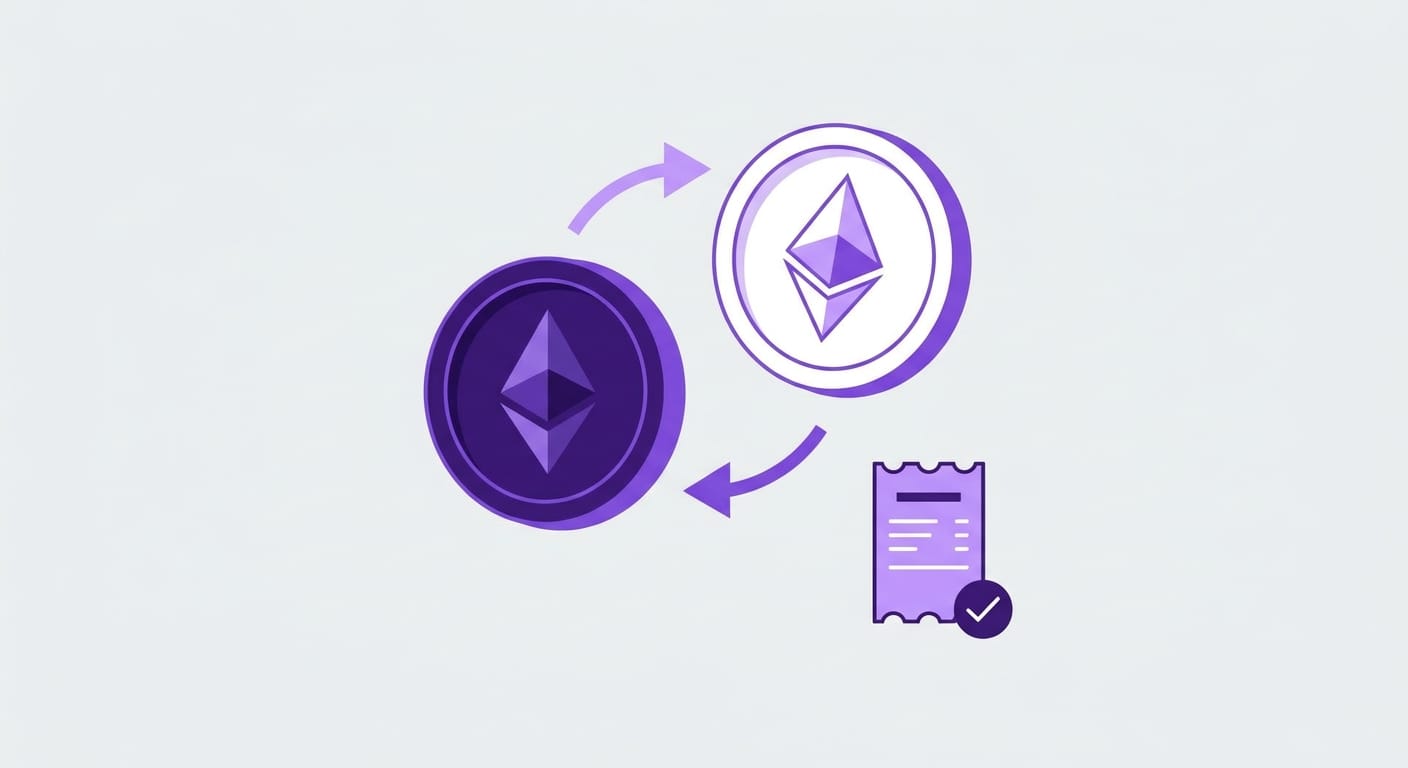
- Every crypto-to-crypto swap is, for tax purposes, a sale of the first asset and a purchase of the second
- The capital gain is calculated using the FIFO method: your oldest lot is sold first
- Did you already hold the asset before 2026? Then the step-up rule applies: your cost basis becomes the market value on 31 December 2025
- The annual exemption of EUR 10.000 applies to your total net capital gain, not per swap
- It makes no difference whether you swap on a CEX or DEX: the tax principle is identical
Last updated: April 2026 · Reading time: 6 minutes
You swapped 1 ETH for USDC on Uniswap last week. Or you exchanged BTC for ETH via a DEX. It may feel like you haven't "sold" anything, just swapped. But for the Belgian tax authority, every crypto-to-crypto swap is a taxable disposal. And that has direct consequences for your tax return.
In this article we explain why every swap is a disposal, how you calculate the capital gain using FIFO, and how the step-up rule can adjust your cost basis if you already held crypto before 2026.
Every swap is a disposal
Under the new Belgian capital gains tax on crypto, every disposal of a crypto asset is treated as a taxable moment. This also applies when you exchange crypto not for euros, but for another token.
In practice: when you swap ETH for USDC, you:
- sell ETH at the market value at the time of the swap
- buy USDC at that same market value
The difference between your original cost basis for ETH and the market value at the time of the swap determines your capital gain (or capital loss).
The capital gains tax law was approved on 3 April 2026 by the Belgian Chamber of Representatives and applies retroactively from 1 January 2026.
How does the calculation work?
Belgian law prescribes the FIFO method: First In, First Out. This means that with every swap, the oldest lot of the sold asset is settled first.
The calculation proceeds in three steps:
- Determine the market value of the sold asset at the time of the swap (in EUR)
- Subtract the cost basis of the oldest FIFO lot you are selling
- The difference is your capital gain (or capital loss) on that transaction
The received asset gets the market value at the time of the swap as its cost basis. That becomes the starting point for any future disposal or swap.
Practical example 1: ETH to USDC
Alice bought 2 ETH in March 2024 at EUR 1.500 per ETH (total cost basis: EUR 3.000). On 15 March 2026 she swaps 1 ETH for USDC on Uniswap. The market value of ETH at that moment is EUR 3.200.
Without step-up
| Element | Amount |
|---|---|
| Sale value (1 ETH) | EUR 3.200 |
| Cost basis (FIFO lot, March 2024) | EUR 1.500 |
| Capital gain | EUR 1.700 |
With step-up
Because Alice already held her ETH before 2026, the step-up rule comes into play. Suppose ETH was worth EUR 2.800 on 31 December 2025:
| Element | Amount |
|---|---|
| Sale value (1 ETH) | EUR 3.200 |
| Cost basis after step-up (31/12/2025) | EUR 2.800 |
| Capital gain | EUR 400 |
The USDC that Alice receives gets EUR 3.200 as its cost basis: the market value at the time of the swap.
Practical example 2: BTC to ETH
Bob bought 1 BTC in January 2025 for EUR 42.000. On 20 March 2026 he swaps 0.5 BTC for ETH. At that moment BTC is worth EUR 85.000 and ETH EUR 3.400.
| Element | Amount |
|---|---|
| Sale value (0.5 BTC) | EUR 42.500 |
| Cost basis (FIFO, 0.5 of Jan 2025 lot) | EUR 21.000 |
| Capital gain before step-up | EUR 21.500 |
Because Bob bought his BTC before 2026, the step-up applies here too. Was BTC worth EUR 78.000 on 31 December 2025?
| Element | Amount |
|---|---|
| Sale value (0.5 BTC) | EUR 42.500 |
| Cost basis after step-up (0.5 × EUR 78.000) | EUR 39.000 |
| Capital gain after step-up | EUR 3.500 |
Bob simultaneously receives 12.5 ETH (EUR 42.500 / EUR 3.400). That ETH gets EUR 3.400 per unit as its cost basis: the market value at the time of the swap.
Impact of the step-up rule
The step-up rule is one of the most important mechanisms for those who have held crypto for a longer period. In short: if you acquired a crypto asset before the reference date (31 December 2025), your cost basis is stepped up to the market value on that date. You can read more about this in our article on capital gains tax on crypto.
In the context of swaps this means:
- All gains you had built up before 2026 are not taxed
- Only the capital gain since 31 December 2025 counts
- Was your asset worth less on that date than your purchase price? Then your original cost basis is retained (the step-up does not work as a step-down)
This makes an enormous difference. In Alice's example, the taxable capital gain drops from EUR 1.700 to EUR 400 thanks to the step-up.
Exemption of EUR 10.000
Belgian law provides an annual exemption of EUR 10.000 on net capital gains from crypto. Two important nuances:
- The exemption applies to your total net capital gain per year, across all transactions (disposals, swaps, spending)
- Capital losses are offset first: if you make EUR 3.000 profit on ETH to USDC but EUR 1.500 loss on another swap, your net capital gain is EUR 1.500
In practice: if your total net capital gain for the year stays below EUR 10.000, you pay no capital gains tax. If you exceed it, only the portion above EUR 10.000 is taxed at 10%.
How Cryptotax processes swaps
Crypto swaps are one of the most common transaction types in DeFi. Cryptotax detects them automatically on Ethereum, Base and Arbitrum, regardless of which DEX you use.
What happens behind the scenes:
- Automatic swap detection: Uniswap, SushiSwap, Curve, 1inch and other DEX protocols are recognised via on-chain event signatures
- Correct FIFO lot matching: the oldest lot is automatically sold first, across all wallets and chains
- Step-up integration: if you held crypto before 2026, Cryptotax applies the step-up automatically
- Cost basis continuity: the received token is immediately assigned the correct cost basis
You do not need to maintain a spreadsheet yourself. Start a free scan and see how your swaps look in a Belgian tax report.
FAQ: frequently asked questions
Is a swap of ETH for USDC different from a regular sale?
Not for tax purposes. Whether you sell ETH for euros on an exchange or swap for USDC on Uniswap, the mechanism is identical: you sell ETH at market value and calculate the capital gain via FIFO.
Does it matter whether I swap on a DEX or a CEX?
No. The taxable moment arises at the swap itself, not at the way it is executed. Whether you use Binance, Kraken, Uniswap or another DEX: the calculation is the same.
Is a wrap (ETH to WETH) also a taxable swap?
In most cases, no. A wrap does not materially change the economic position. Cryptotax recognises standard wraps and treats them as a neutral conversion, not a taxable disposal.
What if I do multiple swaps on the same day?
Each swap is a separate taxable moment. With three swaps on one day you have three FIFO calculations. Cryptotax processes them in chronological order based on on-chain timestamps.
Does entering a liquidity pool count as a swap?
Yes. When you deposit ETH and USDC into an LP, you exchange those tokens for LP tokens. That is fiscally comparable to a swap. You can read more about this in our article on liquidity pools and tax.
Conclusion
Every crypto-to-crypto swap is a taxable disposal under Belgian capital gains tax. It does not matter whether you exchange BTC for ETH, swap ETH for USDC, or trade tokens via a DEX: the FIFO method determines your capital gain, and the step-up rule can adjust your cost basis if you already held assets before 2026.
Want to know what your swaps mean concretely for your tax return? Try Cryptotax for free and get an overview of all your capital gains, including the step-up and the annual exemption.
Further reading? Also check our articles on cost basis and FIFO in Belgium, which crypto transactions are taxable, and the full overview of crypto taxes in Belgium.
Disclaimer: this article is purely informational and does not constitute individual tax advice. For specific cases or edge cases, we recommend consulting a Belgian tax adviser.