Last updated: May 2026 · Reading time: 7 minutes On Reddit, in Telegram groups and at crypto meetups, the same reasoning keeps coming up: "My BTC is on a Ledger, so DAC8 sees nothing, so I don't need to declare anything." Both steps are wrong. DAC8 indeed cannot see a self-custody address, but your obligation to declare does not depend on that…
Last updated: May 2026 · Reading time: 7 minutes
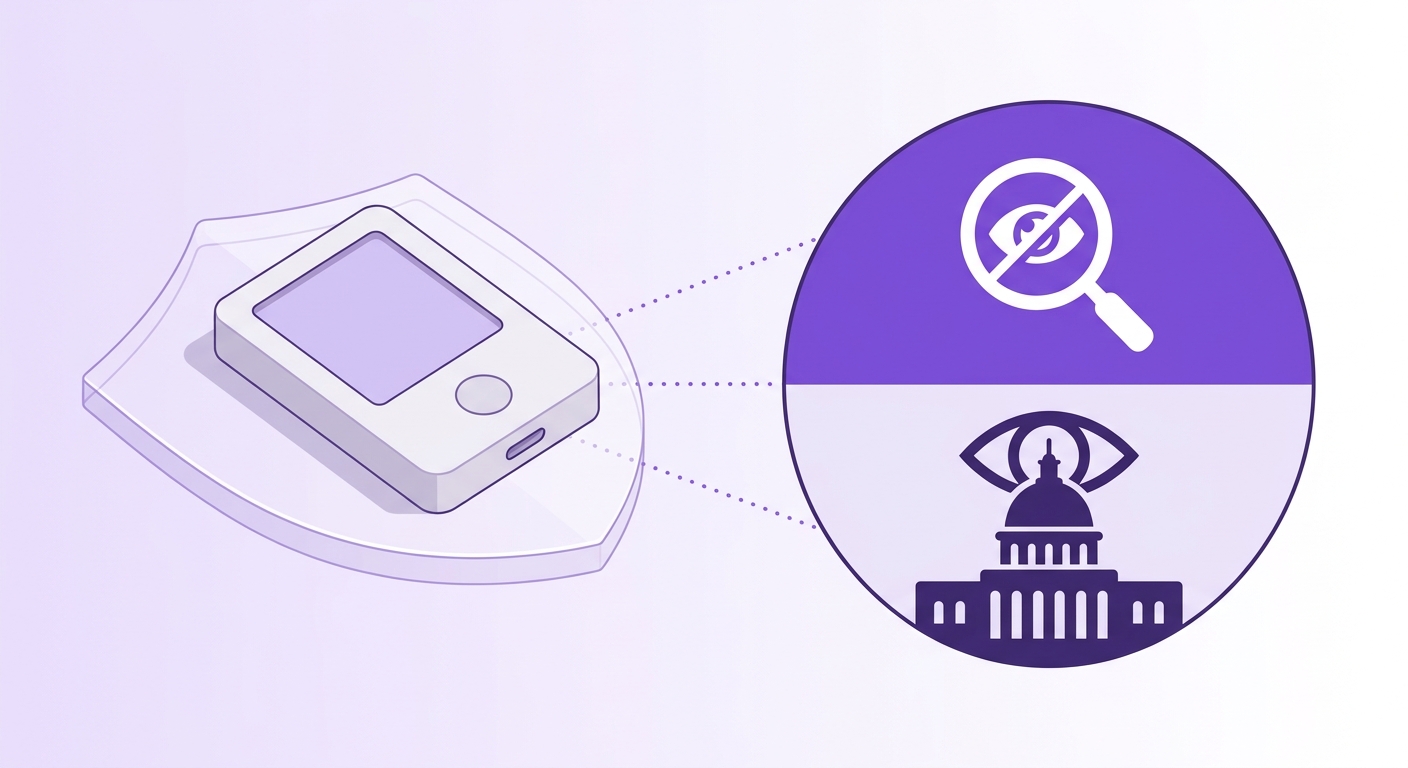
On Reddit, in Telegram groups and at crypto meetups, the same reasoning keeps coming up: "My BTC is on a Ledger, so DAC8 sees nothing, so I don't need to declare anything." Both steps are wrong. DAC8 indeed cannot see a self-custody address, but your obligation to declare does not depend on that. What is more, since April 2026 the Dienst Voorafgaande Beslissingen removed the question "do you hold your crypto on a hardware wallet?" from its questionnaire, precisely because the storage medium is fiscally irrelevant.
This guide sets out what DAC8 does and does not report, why that changes nothing legally, and how to properly document a self-custody portfolio for the Belgian tax authority.
What DAC8 does see
DAC8 requires Crypto-Asset Service Providers (CASPs) to report data on Belgian clients to the tax authority annually. The reporting obligation has been in force since 1 January 2026 and the first crypto data sheets will arrive at FOD Financien (the Belgian tax authority) in September 2027.
Specifically, centralised exchanges such as Binance, Bitvavo, Coinbase and Kraken report:
- Identity: name, address, date of birth, national register number (via self-certification)
- Transactions: fiat-to-crypto, crypto-to-fiat and crypto-to-crypto trades
- Balances: year-end value and semi-annual balances
- Staking and rewards: received rewards and their value
- Withdrawals: also outgoing transfers to external addresses (including the destination address)
That last point matters more than many people realise. If you send 1 BTC from Bitvavo to your Ledger, the tax authority sees via DAC8 not only the amount but also the receiving address. From that point the transaction disappears from CASP reporting, but the starting point of the chain is registered.
What DAC8 does not see
DAC8 applies exclusively to custodial service providers. Out of scope are:
- Hardware wallets (Ledger, Trezor, BitBox): you manage your own private keys, there is no intermediary reporting
- Software and mobile wallets where you manage your own seed (MetaMask, Rabby, Phantom)
- Decentralised exchanges (Uniswap, Curve, 1inch): no central entity, no reportable data
- DeFi protocols (Aave, Lido, Pendle): swaps, lending and staking via smart contracts
- Peer-to-peer sales without an intermediary platform
- Air-gapped multisigs and paper wallets
The core idea: once the private key is with you, there is no CASP in the chain. DAC8 can only report what a service provider registers, and self-custody means by definition the absence of a service provider.
Many investors conclude from this that they are "under the radar". That is a misconception about what the declaration obligation actually entails.
Why this changes nothing legally
The Belgian declaration obligation does not follow from DAC8 but from the Wetboek van de Inkomstenbelastingen 1992 (WIB 92) (Income Tax Code 1992). Two provisions are relevant:
- Art. 90, first paragraph, 9° WIB 92: miscellaneous income from speculative and abnormal transactions remains taxable under personal income tax
- Art. 90, first paragraph, 9° (new) and art. 102 §4 WIB 92: the capital gains tax of 10% on realised capital gains above the annual exemption of €10.000, introduced by the Act of 6 April 2026 and published in the Belgian Official Gazette on 21 April 2026
None of those articles distinguishes between crypto on an exchange, a hardware wallet or a paper back-up. The basis of taxation is the realisation of a capital gain, not the place of storage.
The Dienst Voorafgaande Beslissingen confirmed that position in its most recent updated questionnaire of April 2026. The previous version explicitly contained the question: "Is your crypto portfolio held on a hardware wallet?" In the April version that question has been removed. Ruling practice no longer points to the storage medium because it adds nothing fiscally. What carries more weight: trading frequency, credit financing, derivatives positions and the 25% portfolio threshold.
In other words: not seeing and not needing to declare are two different things. The tax authority relies on self-declaration, supported by the burden of proof it can request.
How to document a hardware wallet portfolio
Self-custody does not mean you have no audit trail. All relevant data exist on-chain; you just need to collect them. The minimum documentation for a Belgian tax return (aangifte):
- List of your own addresses. Per chain (Bitcoin, Ethereum, Base, Arbitrum, Solana, ...) record the public addresses belonging to your wallet. A Ledger generates these deterministically via your seed: an xpub suffices as proof of ownership.
- Source-and-destination linking. For every withdrawal from an exchange to your hardware wallet: keep the exchange confirmation (date, amount, tx hash, receiving address) and the on-chain transaction. That chain shows that funds that were taxable on a CASP remain the same funds on your Ledger.
- On-chain transaction history. Full export of all transfers, swaps, staking claims and NFT movements per address. Etherscan and blockchain.info suffice for individual addresses; for portfolios with DeFi activity an automated tool is more practical.
- Valuation at disposal date. For every taxable event (sale, swap, payment): the EUR rate at the time of the transaction. For pre-2026 holdings also the value on 31 December 2025 as a reference for the capital gains tax.
- Retention period. The tax authority may look back up to 7 years on suspicion of incorrect declaration, and up to 10 years in cases of fraud. Keep everything for at least 10 years.
Good documentation is not a formality; it is the difference between a brief audit and an ex officio assessment. See also the checklist of supporting documents for crypto declarations.
Cryptotax flow for hardware-only portfolios
Cryptotax is built around address-based imports: you do not need to connect an exchange to get a complete tax calculation. For a purely self-custody portfolio the following is sufficient:
- Add your public addresses (one per chain, or an xpub for Bitcoin to automatically import all derived addresses)
- Cryptotax indexes the full on-chain history and automatically recognises swaps, staking, lending, bridges and NFT trades
- The built-in lot matching links withdrawals from exchanges to deposits on your hardware wallet, so that the cost basis transfers correctly
- The report generator delivers per tax year a well-substantiated overview, ready to transfer to your tax return
No API key, no exchange connection, no credentials in the tool. Everything Cryptotax needs is already publicly available on-chain.
Risk of non-declaration
The combination of DAC8 data sheets and on-chain transparency makes it increasingly easy for the tax authority to detect discrepancies. Concrete risk elements:
- Withdrawal trail. A DAC8 report states that you sent 5 BTC from a CASP to address
bc1q.... The destination address is publicly queryable; if those 5 BTC are later sold back via another exchange, the tax authority sees the chain. - Tax surcharge. An incorrect or incomplete declaration leads to a tax surcharge of 10% to 200% depending on the degree of bad faith
- Administrative fine. On top of the surcharge an administrative fine of €50 to €1.250 per infringement is possible
- Criminal prosecution. In cases of serious fraud (from €25.000) article 449 WIB 92 applies, with imprisonment up to 5 years
- Statute of limitations. Standard 3 years, extended to 7 years for inaccuracy and to 10 years for fraud
Those who discover that earlier declarations were incorrect can limit the damage via spontaneous fiscal regularisation: the tax remains due, but fines and criminal risks are avoided.
Frequently asked questions
Do I also need to declare a paper wallet?
Yes. A paper wallet is fiscally identical to any other form of self-custody. The tax authority looks at the realisation of capital gains (meerwaarden), not the storage medium. As long as no sale or swap takes place there is nothing to report, but once you sell the ordinary declaration obligation applies.
What about a multisig wallet?
A multisig (for example 2-of-3 with Casa or Unchained) changes nothing about the tax treatment. What counts is who is the economic owner. With an individual multisig you remain the taxpayer; with a shared multisig (company, partnership, trust) it depends on the legal structure. In doubt? Request a ruling from the DVB.
What if I have lost my private key?
Loss of access is not a taxable event. You have not realised a capital gain. In some cases you can declare a loss, but that is a specific regulation with strict evidential requirements (forensic report, legal declaration, no recovery possible).
I have NFTs on my hardware wallet, how does that work?
NFTs follow the same rules as other crypto assets. Purchase is not taxable, sale is, and the cost basis is what you originally paid (in EUR on the acquisition date). For NFT collections that you actively trade the discussion about speculation versus miscellaneous income is ongoing; that is not a hardware-wallet question but a trading-frequency question.
Staking via a hardware wallet, how do I report that?
Staking rewards are miscellaneous income at the moment of receipt, valued at the EUR rate of that day. It does not matter whether you stake via a Ledger Live integration, a hardware-connected validator, or via a protocol such as Lido. Cryptotax detects staking claims automatically once your address is known.
In brief
- DAC8 cannot see your hardware wallet, but it can see the exchange withdrawal that leads to it
- Declaration obligation follows from WIB 92, not from DAC8. Self-custody changes nothing about that.
- The DVB removed the hardware-wallet question in April 2026 because the storage medium is fiscally irrelevant
- Document addresses, withdrawals and on-chain history for at least 10 years
- Non-declaration can amount to a 200% tax surcharge plus possible criminal prosecution from €25.000
- Cryptotax imports hardware-wallet activity fully address-based, without credentials
Start a free scan and see within minutes which tax obligations apply to your hardware-wallet portfolio.
Sources:
- Wetboek van de Inkomstenbelastingen 1992 (WIB 92), art. 90 and 102
- Dienst Voorafgaande Beslissingen (DVB), updated crypto questionnaire April 2026
- European Commission, DAC8 Directive
- Act of 6 April 2026 introducing a tax on capital gains on financial assets, Belgian Official Gazette 21 April 2026
Disclaimer: This article is purely informational and does not constitute individual tax advice. Consult a recognised Belgian tax specialist for specific cases.