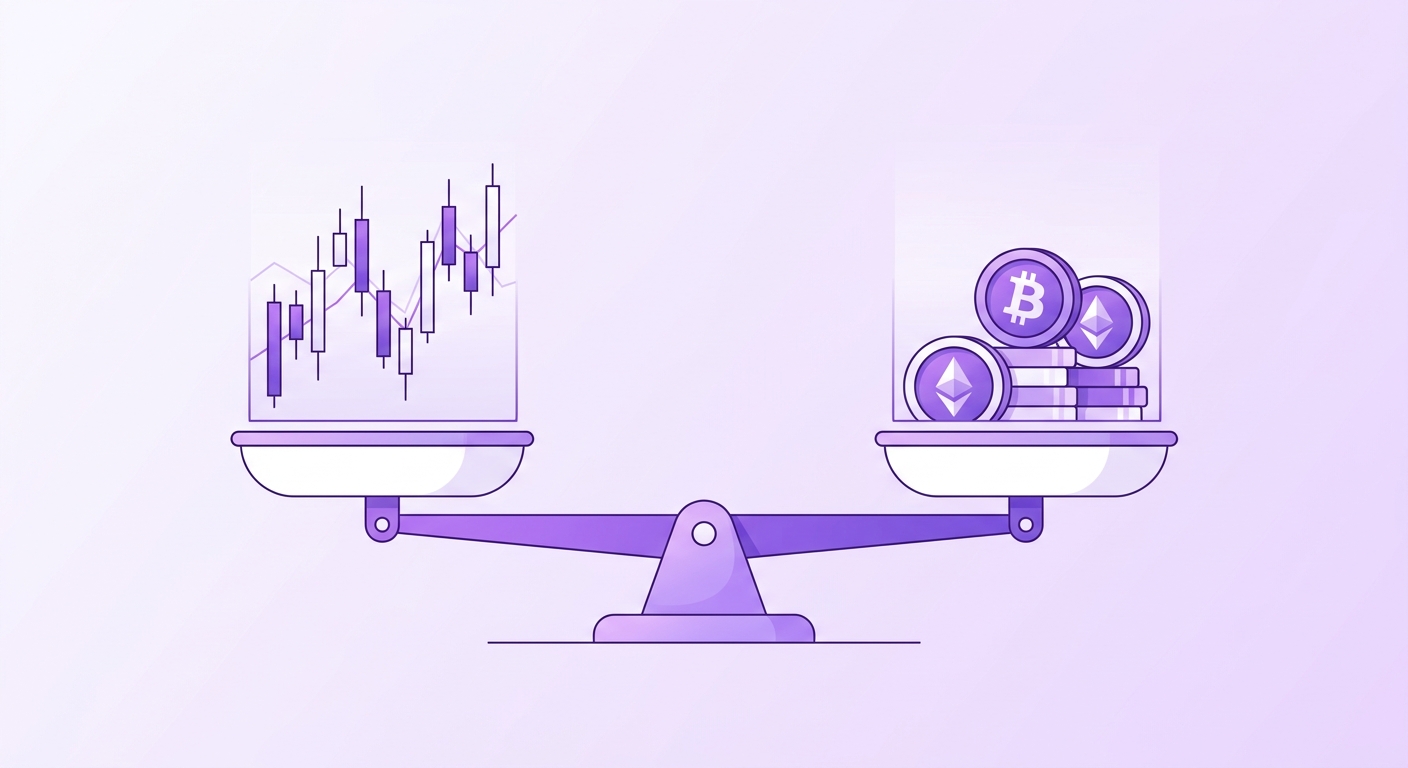

- Crypto losses can be offset against capital gains within the same category (category C) and the same taxable period
- You pay tax on the net capital gain per category per year
- Losses you do not offset are lost - there is no carry-over to a following year
- Pre-2026 losses do not count
- Transaction costs (gas, broker fees) are not deductible
- Offsetting is only possible if you declare all capital gains
Last updated: April 2026 · Reading time: 5 minutes
Under the new Belgian tax regime for crypto assets (10% rate, category C), crypto losses can be offset against capital gains. This is a significant improvement: previously, capital losses on private assets were in principle not deductible. In this article we explain how that offsetting works, what conditions apply, and what to watch out for.
What are capital losses?
A capital loss arises when you sell a crypto asset for less than your cost basis (FIFO). The difference is your loss. Under the new regime from 2026, you may in certain cases deduct that loss from your gains.
Three conditions for offsetting
The offsetting of capital losses is subject to three cumulative conditions:
- Same taxpayer - you can only offset your own losses against your own gains
- Same taxable period - the loss and the gain must both be realised in the same calendar year
- Same category of financial assets - both the loss and the gain must fall under the same category
Category C: what does it cover?
Crypto assets fall under category C, together with:
- Listed shares
- Bonds
- Investment funds
- Investment gold
- Insurance contracts
- Foreign currencies
This means: a loss on crypto can be offset against a gain on listed shares, and vice versa. A loss on crypto cannot be offset against gains from category A (internal gains) or category B (substantial holdings of 20% or more).
No carry-forward to the following year
Losses that you cannot offset in the same taxable period are permanently forfeited. There is no "loss carry-forward" in the Belgian system for category C. This makes the timing of sales relevant: if you realise a large loss in a year without gains, it has no tax benefit.
Full declaration obligation
Offsetting capital losses is only possible if you correctly declare all your realised capital gains. If you declare only part of your gains, you lose the right to offset. This is an important condition that the tax authority can enforce strictly.
Pre-2026 losses do not count
Losses incurred before 1 January 2026 are not deductible under the new regime. Capital gains tax applies only from 2026 onwards, and only losses realised from that date are eligible for offsetting.
Costs not deductible
Transaction costs, gas fees, and broker fees are not deductible when calculating the capital gain or capital loss. Your net sale price and your cost basis are determined without taking these costs into account.
Practical examples
Example 1: offsetting within the exemption
Alice sells two positions in 2026:
| Transaction | Result |
|---|---|
| Sale of BTC | +EUR 15.000 capital gain |
| Sale of ETH | −EUR 7.000 capital loss |
| Net capital gain | EUR 8.000 |
The net capital gain of EUR 8.000 falls within the annual exemption of EUR 10.000. Alice pays no tax.
Example 2: cross-asset offsetting within category C
Bob sells both crypto and shares in 2026:
| Transaction | Category | Result |
|---|---|---|
| Sale of crypto | C | +EUR 25.000 capital gain |
| Sale of shares | C | −EUR 5.000 capital loss |
| Net capital gain | C | EUR 20.000 |
Calculation: EUR 20.000 − EUR 10.000 exemption = EUR 10.000 taxable × 10% = EUR 1.000 tax.
Speculative losses (33% regime)
For capital gains considered speculative, the higher rate of 33% applies. Speculative losses can be offset against speculative gains of the same year, but are likewise not carried forward to a following year. The speculative regime and the 10% regime form separate compartments.
Professional losses
If your crypto activities are classified as professional, losses are fully deductible and can be carried forward to following years. This is a fundamental difference from the private investor regime. The boundary between private and professional depends on the frequency, volume, and organisation of your activities.
Frequently asked questions
Can I offset a crypto loss against a gain on shares?
Yes, provided both fall under category C. Listed shares and crypto assets are in the same category. Non-listed shares (category A or B) do not qualify.
What if I have more losses than gains in a year?
The net loss is forfeited. You cannot carry it forward to a following taxable period. Consider the timing of your sales to realise losses and gains in the same year.
Do gas fees count as a loss?
No. Transaction costs (gas, trading fees, broker fees) are not deductible and do not increase your capital loss.
I had a large loss in 2024. Can I deduct it in 2026?
No. Only losses realised from 1 January 2026 are eligible for offsetting.
What if I do not declare all my gains?
You lose the right to offset capital losses. Full declaration of all capital gains is an absolute requirement.
How Cryptotax helps
Cryptotax automatically calculates your net capital gain per category and per year. The platform applies the FIFO method, offsets capital losses against capital gains, and accounts for the annual exemption. You see immediately how much tax you owe, or how much your losses save you through offsetting.
Start a free scan to map your capital gains and losses.
Want to read more? Check our guides on capital gains tax, crypto tax 2026, and the EUR 10.000 exemption. Or read our blog article Are crypto losses deductible in Belgium?
Sources:
Disclaimer: This article is for informational purposes only and does not constitute individual tax advice. The capital gains tax law was approved on 3 April 2026 but is still awaiting publication in the Belgian Official Gazette. Consult a certified Belgian tax adviser for specific cases.